Showing posts with label intertype relations. Show all posts

Apr 6, 2014

Some Thoughts on Relationships and Socionics

The last 9 months have been very good for me. My life has been steadily getting better and better, and I think I understand enough about why the changes have been taking place to maintain them indefinitely. I'm referring to all sorts of changes relating to nutrition, exercise, sleep, hormones, and neurotransmitters, and also to relationships, social life, work, life strategy, and inner development.

Along the way, I have begun to think about socionics again at times. The first time was when I was pursuing a girl who seemed responsive and interested, but the interaction seemed chronically unstable and off-kilter. After a few frustrating weeks of this, I had the thought, "I wonder what socionics could say about this?" I'll admit that making a good guess at identifying her type (a LIE with a high degree of interpersonal sensitivity) brought some clarity and helped explain the imbalances in the interaction.

Since then I've occasionally (but not automatically) referred to socionics when thinking about other relationships. Experiences with other girls, however, have not exactly fit the socionics model. For instance, I had a fulfilling short-term relationship with an EIE ("quasi-identity"). Luckily, I no longer take socionics very seriously and do not let it influence my romantic choices before the fact. If I did, I might limit myself and fail to obtain experience that conflicts with the socionics model. I think I did this in the past.

Interestingly — as with any idea system — the people who engage in developing socionics are precisely those who take it very seriously... This introduces biases and ideological "overshoot" that the less interested may notice, but rarely take seriously enough to do anything about. Within socionics, as soon as people start to strongly doubt the model, they usually leave the community or become less active and just complain about the discrepancies in the background. Naturally, this is a more or less universal characteristic of schools of thought.

I now believe — as a kind of personal rule — that any relationship can or should be pursued if there is passionate interest. 100% interest and sincerity seems to be a much better predicter of having a really positive experience than socionic factors. However, this assumes that you have the maturity and wisdom to not overstep the natural bounds of the relationship and to not force it to be something that it cannot.

Some people (a lot of men) experience strong romantic interest on a daily or weekly basis. They have to find different rules and formulas for deciding how to pursue relationships and may not relate well to my ideas.

Another observation I've had is that a person may go through stages where they become more or less receptive to different kinds of interaction. For instance, when I am in a "socialite" stage focused mostly on my external social life — going out, meeting people, and doing things with others — the whole type thing can be more or less irrelevant. However, if I enter a more work-focused stage with a lot of focused solitary activity, my need for closer and more "high-quality" relationships increases.

I'm suggesting that in some circumstances a person can be perfectly happy without any dual relations or even any close tet-a-tet relationships. As a person's activities become more focused and idiosyncratic, the need for focused and idiosyncratic relationships seems to rise as well.

In the hunter-gatherer societies that produced modern homo sapiens, people experienced much tighter group relationships and less individualized tet-a-tet relationships. The idea of finding "soul mates" in such circumstances becomes largely irrelevant. I believe that a failure to understand or even think about the relationship structure of primitive societies has led to many of the erroneous ideas contained in socionics. As some readers may know, Augusta Augustinavichute believed humans were a pair-forming species and examined their relationships in a modern (actually, Soviet command economy) context only.

I've had the chance to mingle in a lot of different groups of late. Certainly, different groups have their different "feel," and socionic quadras is one way to look at it. However, some of us are used to feeling like outsiders in virtually every group we find ourselves. Thus, using comfort level as a way to identify quadras may lead to never finding one's own quadra because every group is uncomfortable — just to different degrees. For such people, the idea of quadras and their defining role in establishing the culture of a group can be pretty much irrelevant.

In a "socialite" period of life, you may flit from group to group with ease, but few of the groups are particularly well-established or display any set rules and "quadra flavor." As your life becomes more work-focused, you will probably find yourself spending time in more well-established groups. Obviously, the longer a group has existed and the more fixed its membership, the more rigid the culture of the group will be. I think there's much value in belonging to such a group(s) at some point in life.

I often return to the concept of "highly sensitive people" and observe how these people systematically do not fit into socionic type and relation models. They might as well be a different ype, and can be divided into extraverts (roughly 1/4 of HSPs) and introverts (roughly 3/4). Most are intuitive types, but there are also some introverted sensers among them.

I really strongly doubt that an HSP IEI's ideal match will be any kind of SLE, though many aspects of the relationship may be comfortable and convenient. But an HSP is subject to some kinds of feelings and experiences (states of sensitivity, solitude, loneliness, restriction of sensory stimulation, etc.) to a much greater degree than non-HSPs, and will need to find others who can relate to this "deeper" level. If an HSP lacks a deeper sensitivity-based connection with his partner, he may experience loneliness and even alienation.

I find that HSPs tend to have a mixture of intuitive and sensing qualities and often logical and ethical qualities that perhaps make it less important to have a partner who is at the opposite end of these axes (particularly intuition/sensing).

I'm not sure these axes are even a good way to think about relationship compatibility anymore. One of the reasons they enjoy popularity it because they give people them something to think about before the relationship has occurred. It can actually be akin to voyeurism. By thinking about your compatibility or incompatibility (or that of other people) with someone before a relationship has actually begun, you can 1) fantasize about a relationship that does not yet exist, 2) fantasize about other people's relationship (this is more of a female thing), and 3) justify your own inaction in pursuing someone you are attracted to.


I have a lot more to say on the subject of relationships and well-being, but it is all unrelated to socionics, so I will just abruptly end this post here.

Oct 26, 2012

Highly Sensitive People and Socionics

last edit: 31 Oct 2012 (theta brain state)

Introduction 


I recently learned of a trait commonly termed "Highly Sensitive Person," or HSP. This is a trait I have long wondered about in myself and others and have called different names at different times (e.g. self-awareness, introspectiveness, sensitivity, etc.). I used to loosely associate it with ectomorphy; I think I was identifying a kind of ectomorphic variety of high sensitivity and ignoring other varieties. Since then I've noticed HSP traits in people of different somatotypes.

After investigating the subject, I'm convinced that it is a very influential personality trait that has important ramifications for intertype relations and personal development. So influential is the trait that HSPs may be practically untypeable socionically, having a set of traits that appears to conflict with or override typical type traits.

Further information online


In addition to the Wikipedia article, there is some really good information available in research articles on Elaine Aron's site, as well as large amounts of personal accounts and feel-good sites on the subject online. Lots of podcasts and interviews on the subject can also be found.

Distribution


According to studies, 15-20% of the population is HSP, and the numbers are evenly distributed among men and women and hetero- and homosexuals. The numbers are about the same for different nationalities, though different cultures may be more (e.g. Japan) or less (e.g. U.S.) accepting of the trait. Of particular interest is that the trait is also observed in animal species.

Psychological and physiological aspects


It is speculated that roughly 50% of psychologists' clients are HSPs. HSPs are more sensitive to childhood experience and display more maladaptive behavior with suboptimal upbringing and more well-adapted behavior with optimal upbringing relative to non-HSP children.

HSPs appear to be more prone to certain mental and physical conditions, such as neuroses, Irritable Bowel Syndrome, etc. Their brains appear to spend more time in theta state — typically, a drowsy or meditative state — which may indicate more reflection/"recharging" and deeper processing of impressions received during their daily activities.

I would estimate that 30-50% of socionics aficionados are HSPs and that these are many of the same HSPs that are likely to end up in counsellors' offices.

HSP and Asperger's Syndrome


Both of these groups have their online "fans" and often resemble pop-psychology. I've seen lists of famous people who supposedly had that or the other trait, and there was quite a bit of overlap... My personal opinion is that many psychological conditions are overdiagnosed. I myself have been wrongly labled as "high-functioning autistic" by at least two non-specialists who only saw me in certain settings. Of course, this did nothing to improve our interaction... While many AS and HSP online hobbyists seem confused about which diagnosis to give themselves, this article makes a good attempt at separating the two.

Difficulties with the HSP construct


Upon learning about HSPs, a lightbulb flashes on in your mind and many things begin to make sense. Then, once you start identifying sensitivity levels in different people, you realize that each HSP has a different variety of sensitivity, making it hard to generalize. Things that you would tend to attribute to sensitivity in yourself are absent in other HSPs, and vice versa. The search for an overarching, fundamental HSP trait runs into the needle-in-the-haystack problem that plagues socionics and other personality characterizations.

The exact nature of high sensitivity is not yet entirely clear (e.g. "processing sensory data much more deeply and thoroughly"), but there are some interesting lines of research that suggest that the trait can be pinned down physiologically and/or through behavioral testing. That is much better than personality questionnaires which are subject to biases and misinterpretation.

A problem with practical application of the HSP construct is that it has no well-developed counter-category with a potentially positive image — e.g. "low sensitivity person, or LSP." People only read about HSPs and may incorrectly self-identify with it because it seems to suggest creativity or intelligence or provide justification for problems they may have experienced. HSPs, on the other hand, are probably unlikely to wrongly identify themselves as non-HSPs.

Highly Sensitive People and Personality Type


In terms of the MBTI, introverted intuiters were most likely to be HSP, followed by extroverted intuiters and lastly by introverted sensers. Most HSPs are MBTI introverts, and extroverted sensers were not found among the admittedly small sample group studied (I believe under 30). Keeping in mind MBTI type skews relative to socionics, I would expect the trait to be more evenly distributed among the socionics types. For instance, I think I have known at least two SLE HSPs and at least one LSI, two LSEs, a few ESEs, two ESIs, and probably at least one SEE, not to mention many intuiters and SEIs and SLIs.

One can take the approach of examining the trait in isolation from socionics types, or in the context of types. The second approach might help one to identify the uniquely HSP-specific characteristics that are always present regardless of the type, but the risk is becoming too conceptual about the trait. The first approach often leads people to inject too many of their own individual qualities and experiences into the trait.


Effects of sensitivity on socionic type


High sensitivity seems to have a huge effect on personality. In my experience, the HSPs I know are all psychologists in a way and are particularly sensitive to other people's emotional lives and internal experience. They are all at least a bit brooding and are introspective and focused on processing their personal experiences. This is true whether their type is IEI or SLE, EII or LSE.

Such is the sensitivity of HSPs that an HSP LSE may be far more interested and thoughtful about things like perception, trauma, and overcoming internal obstacles than a non-HSP EII (this is coming from my personal experience). Non-HSP LSEs may listen to discussions of these topics with interest, but they have relatively little to say about them or their comments lack depth.

HSP SLEs, LSIs, ESIs, LSEs, etc. tend to lack the callousness that is often attributed to their types. On a philosophical level, HSP types with extraverted sensing (SLE, SEE, LSI, ESI) may reject any form of interpersonal coercion and may be wholly uninterested in politics, power, etc. They may often seem "unsure of themselves" or hesitant, and their extraverted sensing may seem to "flicker" on and off. Of course, this is all happening in the mind of the observer, who has a construct of what extraverted sensing is and is not. Without that mental construct, there's probably nothing particularly paradoxical about an HSP's behavior.

HSP ILEs and IEEs I have known (myself included) appear less extraverted than their non-HSP counterparts. More time is spent ruminating about things within oneself, and less time is spent gathering and distributing "random," superficial information, which is more typical of non-HSP ILEs and IEEs.

Effects of sensitivity on socionics schools


The best example of this I can think of is the contrast between Yermak's hard-headed analytical socionics and Gulenko's School of Humanitarian Socionics. Both are LIIs, but the first is non-HSP while the second is HSP.

Effects of sensitivity on intertype relations


HSP-ness seriously impacts intertype relations. The "truest" form of many potentially adverse intertype relations, for instance, is when an HSP is affected by a non-HSP. In other words, an HSP SLE may be more traumatized by a non-HSP ESI than a non-HSP SLE. Put an HSP ESI in place of the non-HSP, and the "supervision" would likely be seriously altered. A HSP IEE might not be much of a "supervisor" at all to a non-HSP ESI. The effect of the supervision might be so gentle as to basically be negligible for the ESI. In fact, the "supervisor" HSP IEE might well experience more distress as a result of the interaction as the "supervisee" ESI.

An HSP child might find even virtually optimal intertype relations with parents to be "traumatic," while another non-HSP child gets by just fine with parents from a completely different quadra. HSPs seem to need things to be "just right" in order to feel good in relationships and in general in life. As a missionary at age 19-21, I experienced many varieties of poor-to-awful relationships and just a few good relationships with missionary companions, while many non-HSPs seemed to "have a great time" with just about everyone they worked and lived with. So much for intertype relations!

Duality and sensitivity


Dual relationships may be quite different depending on partners' sensitivity levels. Two HSPs will probably have higher levels of understanding, but may need to take great care to regulate personal space and autonomy in order to avoid feeling "repressed." An HSP with a non-HSP may experience less mutual understanding, but the non-HSP may provide a greater degree of emotional stability in the relationship. Two non-HSPs may have a more stable and conventional relationship and fewer problems regulating optimal emotional/physical distance.

These are just suggestions, since I would need a lot more relationship experience than I have to make any far-reaching generalizations. Elaine Aron comes to similar conclusions, saying that both combinations have pros and cons but that she believes two HSPs together is probably a better combination than an HSP with a non-HSP.

Comments


I'm particularly interested in readers' comments on this post. I'm sure people will have a lot to say. 

Oct 3, 2011

Socionics Inaccuracy in Relationship Compatibility

In my opinion, socionics is inadequate as a predictor of romantic compatibility. It is quite a bit better than chance, which is remarkable in itself. However, it does not live up to the expectations many people acquire when studying the theory.


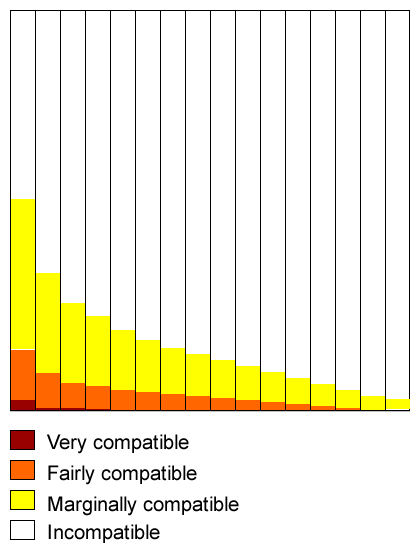
Here I present two graphs representing (approximately) romantic relationship compatibility distribution among types 1) as suggested by socionics theory, and 2) in practice (in my practice, at least). There are 16 vertical cells in each graph, representing the 16 types.

1. What socionics seems to suggest


What exactly socionics suggests is highly debatable. Some socionists introduce subtypes and use them to further model intertype compatibility. Some socionists talk of the difference between functions and the "specific content of the functions," which depends upon culture and upbringing (a copout explanation, in my view). Some introduce levels of development or intellect which may influence compatibility. Nonetheless, the above picture represents what many or most people seem to think after beginning to study socionics. It often takes many years for the understanding above to gradually morph into something more like the following:


2. What I observe in practice

The height of the colored bars may differ from person to person depending on how far they are from the mean on various physical, intellectual, emotional, and cultural traits. The graph above shows 1 in 40 duals as being "very compatible" and just over half as having some degree of compatibility. For some people even this may be optimistic.

Note that there is no "ideally compatible" category in the second graph. In my opinion ideal compatibility does not exist. It is not built into our biology. Compatibility is a kind of reasonable compromise between two individuals who agree to set aside one set of programs (mate seeking and individualistic behaviors) in favor of another set of programs (relationship building, homesteading, and child rearing behaviors). The socionics model does not reflect this in any way.

Furthermore, romantic compatibility in practice may change during a relationship. The stage of romantic love increases the appearance of compatibility greatly no matter what the intertype relation. As hormone levels gradually return to normal, compatibility may either decrease or increase depending on "underlying" compatibility. Even in a seemingly compatible relationship, there is no guarantee that for one reason or another one or both partners will opt out of the relationship.

There is substantial evidence that humans have a mixture of monogamous and polygamous tendencies and that as a species we are designed with the potential for both life-long monogamous relationships and multiple relationships, whether simultaneous or sequential. The mechanisms whereby people are motivated to switch relationships throw a wrench in the neat system of compatibility suggested by socionics. Again, socionics has nothing to say about these vital biological factors and suggests a simplistic view of compatibility that requires numerous qualifications and provisions.

Next, homo sapiens did not evolve in a nuclear society where people separated into pairs and isolated themselves socially and economically from others. For the most part, homo sapiens lived communally, and intimate romantic relationships were complemented by a complex network of other supporting relationships. In this kind of setting individual compatibility may be less important than in a distinctly nuclear society.

Finally, adult mortality was quite a bit higher than today, and it was quite common for women to die in childbirth. Health, fitness, and ability to provide were probably just as important provisions for choosing a mate as psychological compatibility. After all, what our genes are after is maximum replication. How much this goal favors the evolution of a rigid system of psychological compatibility is an interesting question (I believe I have an article about that at Socionics.us).

It seems to me that the larger and more complex the society, the lower the percentage of romantically compatible mates. As specialization and the web of interpersonal communication increase, people settle into ever more specialized cultural niches. As the complexity of society increases, people with extreme traits have more chances to find each other and produce offspring with even more extreme traits who, in turn, have a harder time finding compatible partners. In a society where one must find a mate within a community of 1000 or so people, out-of-the-norm traits may tend to be quickly brought closer to the mean because of the low probability that you will ever meet someone else with the trait.

If one can realistically choose from only 100 potential mates and knows of no others, one will find a relatively compatible mate among the 100. If there are only 10 mates, one will find the most compatible one of the 10. The smaller the number of people in a certain mileau, the less cultural and psychological diversity there will be.

Dec 8, 2008

Clarifying "Quadra Values"

"Quadra values" is one of many socionics terms that is repeated often and yet understood litte. I would like to venture a technological explanation of the term that will also help to clarify some of the roots of intertype relations.


Everyone acknowledges all socionic functions and believes they have a rightful place in life. For instance, who would object that people in a competition are trying to beat each other? Or who believes that people should never get mushy and sentimental when they're in love with someone? Or that people whose job it is to forecast should not speculate? No one objects when Alex Trebek (Jeopardy game show) bluntly tells people on his show that they are "incorrect." These are approaches that are inherent to the activity.

Thus, if your conflictor is ESE and you are exposed to him or her using extraverted ethics in an extraverted ethics situation, it probably won't bother you, even though extraverted ethics is your "vulnerable function." What will bother you are uses of extraverted ethics in ambiguous situations or, even more importantly, in situations where you feel a different approach is more justified.

What differs fundamentally among quadras and types are responses to situations where a socionic function is being used outside the inherent domain of that function. For example, being robotlike in an interpersonal situation that demands sympathy and warmth, or appealing to personal sentiments in the context of scientific discourse. Or being overly individualistic and attention-getting when cooperation and trustworthiness are called for. If Alex Trebek continued to routinely tell people they are incorrect outside of his game show, many people would view him as being callous and rude (however, most duals will probably view this is a sign of admirable honesty and sincerity), even though it is perfectly acceptable in the context of Jeopardy.

Basically, if the function that is "overstepping" its bounds belongs to the quadra values (the four valued functions of the quadra, corresponding to the four base functions represented in the quadra), it is viewed as a "minor weakness," a "good joke," or a "sign of sincerity." If the function, however, is not among the quadra values (i.e. is one of the four "suppressed" functions), then overstepping the natural bounds of that function is viewed as "showing off," or as something counterproductive, malicious, or even sinister. 

Naturally, people view their own leading function as the most benign thing in the world and don't see anything wrong with applying it freely to just about anything. Then comes the suggestive function, which they may learn to grant the same range of expression (in others, at least) as they grant themselves in their leading function. Everything else, though, needs to be cropped, caged, and harnessed to make way for the free expression of these functions. So, while an ILE grants free reign in applying extraverted intuition and (if he's lucky) introverted sensing to nearly anything in the world, he sincerely believes introverted ethics must be limited to Mother's Day cards and eulogies. When he oversteps the natural bounds of extraverted intuition, it's just "practice" or "fun and games," but one someone else oversteps the natural bounds of introverted ethics, it's a deadly sin. 

So, to recap, peoples' negative reactions to use of certain functions occurs when they perceive someone to be applying the wrong function for the situation. There's nothing inherently negative about one's vulnerable function; one is just particularly sensitive to overuse of this type of activity or approach.

"Dyad values"
Values differ somewhat within quadras as well. For instance, in Beta Quadra, the LSI and EIE dyad (dual types) are more forgiving of overdoing things with introverted logic and extraverted ethics and a little less tolerant of overdone extraverted sensing and introverted intuition, though they still remain generally sympathetic. 

Application
I believe this explanation has some constructive applications. For instance, if you want to avoid conflict, then try to resist natural, lazy impulses to overstep the natural bounds of your Ego functions, and instead try to appreciate (and possibly learn) the "best practices" inherent to each area you venture into rather than compulsively applying your leading function behavior to everything you see. Other types will be sure to point out your "errors."

Aug 4, 2007

The Draw of Unfavorable Intertype Relations

Given the difficulties inherent in such intertype relations as conflict, Super-Ego, supervision, and others, one might wonder why people would ever choose these relations for romance and even marriage. Wouldn't the lack of harmony and cohesiveness destroy the relationship from the onset?

Naturally, it all starts with physical attraction. People can find themself attracted to someone of any type, and biological programs kick in that encourage people to lower barriers regardless of psychological comfort levels. After all, the early stages of nearly any romantic relationship are uncomfortable, and the psyche is well-equipped to handle this.

A likely draw of conflict, supervision, and Super-Ego relations is that positive input from these types is flattering to the individual. It gives you a big self-esteem boost when you can get these types to like you and evaluate you positively. One feels like one has overcome a huge challenge to establish a relationship, and this fact is highly prized. Partners are united by the shared challenge of overcoming the huge distance between them to find a common language and somehow be close.

These relations take a lot out of partners and leave them quite worn out, especially after the initial romance is gone. Partners tend to slip back into their own language and interests and to limit their interaction with each other. If they respected each other to begin with, a sense of flattering (because of positive input on one's Super-Ego functions) mutual respect may remain, but gradually the relationship exerts a toughening and tiring influence on partners. The distance cannot be bridged after all.

Relations of conflict usually lead to a quiet separation of functions and limiting of interaction to a formal minimum. Usually partners lose their spontaneity around each other. Super-Ego relations invite more direct interaction and spontaneity but are famous for their outspoken conflicts and mutual accusations that always lead to a stalemate. Relations of supervision lead to bitter tears and feelings that the supervisor refuses to value the supervisee for who he is.

Dec 22, 2006

Intertype Relations

A basic difference between socionics and other typologies is socionics' theory of intertype relations. Socionics is not just a typology of personality or fundamental psychological characteristics, but a typology of perceptual traits that define one's relationships with others. Hence, we should not be surprised if we encounter some personality differences between individuals of the same socionic type — as long as we see that there is a similar pattern of intertype relations.

Socionics describes 16 intertype relations between each type and any other (16 including his own type). Each type has the same set of 16 relations, but with each relation corresponding to a different type. Intertype relations are determined by taking the function layout of one type and comparing it to the function layout of another. 16 possible patterns results.

Intertype relations describe the nature of interaction and information interchange between two people at a close psychological distance in terms of how partners' psychic functions interrelate. These socionic relationships range from very difficult and potentially harmful to one's self-realization to very beneficial and relaxing to the psyche. Intertype relations play a large part in one's choice of friends and informal relationships, where one tends to focus on ease of communication, pleasure, and mutual benefit (cooperation).

Dec 19, 2006

A Peculiar Trait of the Base Function

Recently I have been able to recognize a common thread in base function-determined behavior among literally all the people I know. This characteristic seems to be a fundamental source of conflicts with one's conflicters and supervisors. In these relations, the weak and limited fourth function of one partner interacts with the strong and absolute base function of the other.

The trait is that the base function processes information very rapidly and efficiently and jumps to conclusions without the individual realizing it. The base function synthesizes stored-up experience and new bits of information along its path and produces a conclusion quickly and confidently. The individual likes to share the resulting thoughts and opinions with others, not necessarily because he is sure he is right, but as a way of "flexing" his mental muscles.

A conflicter or supervisee (see chart at top right column) can be highly irritated by this if 1)these conclusions touch upon his vital interests and 2) if he doesn't agree with the person's conclusions (when people are not connected by a common vital interest, they usually just wave people like this off and go their own way).

When explaining how they reached conclusions related to their base function, people inevitably leave out some stages in their mental process. Some of the stages one finds too "obvious" to expound on; others one is not aware of. To their conflicters and supervisees, this makes it look as if the conclusion is arbitrary or based on an irrational "belief," when in fact it is based on a long string of deductions and a large body of experience that the individual is not inclined or able to elucidate.

Since the person's vital interests are at stake if the conflicter's or supervisor's conclusions are correct, he fights back by criticizing the latter's viewpoint, trying to uncover the errors and incorrect assumptions of the other (assumptions is really the key word in this type of conflict). This causes strain on the plodding fourth function. What's worse, the "offender's" views almost never budge at all, because they are based on a vast system of observations and experience.