Feb 14, 2012

Why Socionics Is Awesome

Amidst all the angst of the socionics community and my own frequent critiques of socionics as a half-baked system not particularly conducive to scientific progress, I sometimes forget my own personal experience of socionics, which is that… socionics is awesome.

So, lest I be mistaken for another disgruntled ex-socionics junkie, let me lay out the ways in which socionics has been an extremely worthwhile and positive school for me.

1. Socionics can easily be used to improve quality of life. For over a year after learning about socionics (age 23), I experienced virtually no interpersonal distress for the first time in my conscious life. Granted, much of this was due to the fact that I was in a constant state of private intellectual discovery and thus was not as sensitive as usual to real or perceived negative interpersonal situations (disagreements and conflicts, loneliness, lack of acceptance, social awkwardness, etc.). But mostly I attribute it to the fact that I had begun applying a constructive, socionics-based approach to managing my emotional and social life, consisting of: 1) a recognition that my emotional state is less the product of my own making than the result of my social interactions; particularly 2) the quality and depth of my connections to people of various personality types; specifically 3) whether I am too emotionally connected to the wrong types or too distant from the right types; suggesting that 4) emotional life can be improved by reducing emotional investment in one set of people and increasing investment in another set.

At first this required a kind of willful restructuring of my interpersonal connections, but eventually it became second nature. This formula clearly works — if it is not too compounded by other issues. I consider it one of the most important life skills, right alongside things like learning to provide for yourself and manage money, avoiding addictions, and taking care of your physical health. Some people are raised with one or more of these skills and may never appreciate what it takes to acquire them through conscious effort. Like these other life skills, keeping your interpersonal life in order requires a certain amount of self-love. No one else is going to do it for you.

Over time my understanding of what kinds of people are "right" or "wrong" for some kind of emotional interdependency has grown to include a lot more than simply socionic type. But the foundation for this skill was laid by socionics.

Positive relationships, particularly intimate ones, impact one's life in a variety of ways. If you have an idea what you're looking for — even if it's as simplistic as "a dual relationship" — that probably increases the chances that you'll find it. I'll never know how much of my romantic success or failure has been due to socionics, but I consider myself quite fortunate considering where I was coming from and what I have experienced so far in life. It could have been a little bit better, but it could also have been far, far worse.

2. Socionics is a secret weapon. My own socionics schooling — which included ruminating over the writings of Augusta (other authors' writings seemed dull in comparison), large amounts of introspection, studying my reactions to people, observing them closely and trying to identify their types under the guidance of a skilled but imperfect teacher, over a hundred hours of poring over photographs trying to recognize personality traits in facial features and expressions, and eventually meeting other socionics aficionados — brought to my awareness many things that had previously been unconscious. At the time it felt like I was acquiring a secret weapon that made my responses to the outside world less blind or mechanistic than other people's. When I realize at what level most other people think about the people around them, using conventional descriptors such as "nice," "good," "dull," etc. and assuming the superiority of their own psychological makeup, I'm eternally grateful to have undertaken a serious study of people and relationships and to have a more objective understanding of why I experience different feelings towards people.

Socionics also makes it easier to recognize and take advantage of numerous "shortcuts." Having a feel for someone's type (or at least elements of their type) allows you to build beneficial relationships quicker than otherwise, particularly if you have accumulated a large body of experience dealing with people of different types. Knowing that there is someone you will be able to confide in and rely upon to some degree may encourage you to take that risk and move to a new location that you feel will be better for you. Or, you may more quickly realize when you are in a bad situation due to the types and prevailing culture of a group you have landed in. A knowledge of socionics provides a more sophisticated feel for how much and in what ways you may be able to rely on someone and, in turn, be useful to them. This can help in choosing employers, partners and assistants, hobby groups, and roommates, not to mention romantic partners.

The caveat is that spiritual and interpersonal choices work best when they are based foremost upon feelings, not mental concepts, so it is very important that you develop an understanding of socionics that is congruous with and highlights your actual emotional experience rather than letting ideas about what you "should be" experiencing according to some interpretation of socionics take precedence over your actual feelings. This one caveat basically encompasses all the potential negative side-effects experienced by so many socionics aficionados. This is a complex problem not at all unique to socionics, and I no longer blame socionics for it. When a school of fish changes direction, it could be said that only the lead fish — the one with the strongest internal compass relative to herd instinct — is following her "true instincts." For whatever reasons, the other fish choose to repeat her movements instead of trying to access their own internal compass — at least, until a greater stimulus (e.g. predator) comes along, temporarily overriding the imperative to "follow the fish in front of you." The issue of negative side-effects of socionics is actually a fundamental and intractable "internal compass vs. external suggestion" problem. It's probably best dealt with individually by strengthening the internal compass (as if it were that easy!) and distancing oneself from the source of suggestion, if necessary. But if a person is able to do this at all, they probably didn't have much of a problem to begin with! Suggestibility exists, and it serves a function for the individual and for society. If people were insusceptible to suggestion, there would be no person-to-person learning.

3. Socionics can trigger a cascade of new intellectual pursuits. Before socionics I had less than a layman's understanding of science and hadn't seriously grappled with its big ideas. I had developed a theologically centered worldview that was clearly at odds with reality and insulated me from scientific and philosophical thought. As imperfect a scientific theory as it is, socionics suggested to me a simple universal principle that gradually undid my entire worldview: all things have their causes. I realized that up till then I hadn't really concerned myself with the causes of things, but had gone around in mental circles trying hopelessly to live up to acquired religious ideals. At first I applied this cause-and-effect idea to the emotional and interpersonal sphere (see #1), but soon began examining everything in its light. I became fascinated by thinking about phenomena divorced of moral judgments and reflecting on the likely material causes of things, eventually formulating my interest as follows: I want to know what is, not what is supposed to be. Later I formulated: the rejection of faith as a guiding principle is the very foundation of science. There's no good reason to have to stop asking "why?" — at least inside yourself — when you reach things that you or anybody else would like to be true but actually have no compelling reason to believe.

Through socionics I became interested in psychology and got a minor in the field. A couple lectures into psychology, I realized that the foundation of modern psychology was evolution. So I began reading about evolutionary psychology to mine it for important ideas, and soon read Darwin's Origin of Species for background, gaining a great admiration for scrupulous rational thought. Then I did quite a lot more reading on evolution, biology, memetics, and the philosophy of science. I literally felt my mind expanding; I could think thoughts that just a few months before had been totally out of reach. Later I would learn to appreciate philosophy in general and read widely in esoteric spirituality. Once I began developing Socionics.us and Wikisocion, socionics became a springboard for learning more about art, music, and history. All this careful thought and reading greatly stimulated my intellectual life and contributed to me later becoming a writer.

Oddly enough, I've never met anyone who experienced anything quite like this as a result of learning about socionics. To many people it sounds as strange and counterintuitive as a waiter becoming a fighter pilot as a result of ballet lessons. Clearly, my particular intellectual response was determined by the mounting tension between my acquired religious worldview and my natural disposition. Nonetheless, I will never forget that it was socionics that opened the floodgates.

4. Socionics encourages and rewards braininess. Sure, there are plenty of people in socionics with personal problems; that's what brings most people to it in the first place. There's nothing shameful about that. Why would you ridicule scrawny or overweight people who go to the gym? But most people who get into socionics are also smart, and it can become a kind of social refuge for brainy people who lack community. It's okay to be smart in socionics, to speak (write) using nerdy terminology, to defy conventional wisdom and present your own wacky ideas to be shot down by others whom you can call names like "conservative" and "orthodox." Sure, there are some people who just pretend to be brainy (just as there are people at the gym who pretend to be buff), but at least the community culture rewards braininess due to the nature of the subject. When I first got in contact with the Ukrainian socionics community, particularly publishing or researching socionists rather than aficionados, it was the first place I had been where you could be as brainy as you wanted. All the communities I'd experienced before that — even my high-achiever high school and university — still had this attitude like, "Hey now, don't get too brainy on us here, hahaha." Through socionics, I've met some really intelligent people that I wouldn't have met otherwise. This has been really valuable to me. Since then, I've found a few other places where braininess is accepted and rewarded, but socionics was the first.

5. Socionics opens the door to higher levels of objectivity, helping to weed out typocentrism and other kinds of biases from one's worldview. It allows you to see, as William James says in Pragmatism, that each man's philosophy is merely a justification of his native disposition. We will likely continue to act in typocentric ways, but at least we can begin to remove biases from our conscious values and worldview, granting other people the possibility of living a legitimate and dignified life according to our own definitions, though we choose to live differently. A study of socionics clearly suggests that 1) there are different legitimate life strategies, each with its potential pitfalls, 2) no type-determined trait can be considered a defect in any sort of intellectually honest way (i.e. such a defect is in the eye of the beholder), and 3) many of the things that bug us in other people are outgrowths, or extreme expressions, of fairly typical and basically benign qualities, thus 4) the "defect," if any, is in the disbalance or misapplication of traits, not in the underlying traits themselves. From these thoughts it seems natural to conclude that 1) each set of traits has its place and its purpose, 2) your own traits may "feel" superior, but only in some abstract ideal sense, as natural selection has decided otherwise by not granting them to everybody.

For me, these realizations have encouraged me to look beyond what works only for me and people like me and look for formulas that are more universal. At some point, I realized that philosophical acceptance of other temperament-determined strategies could itself be considered an extreme viewpoint, given that rejection thereof is a far more common occurence. Most likely, I am in fact less philosophically accepting than much of my writing suggests, and militant promoters of a temperament-specific philosophy are actually not as militant as they appear. In certain situations, I might turn out to be more vehement than them. At any rate, thanks to socionics I am able to think about these things much more clearly, recognizing potential biases as they crop up in myself and others.


So, there you have it. Socionics is awesome! Despite the lack of empirical studies and other flaws, and despite all the caveats and pitfalls. Probably, after reading this article, you will have realized that each person's response to idea systems is highly individual.

Feb 4, 2012

Socionics Model and Associations

Here's most of a letter I wrote recently regarding my typing of person that was discussed at the Polish socionics forum:


The fact is, all socionists type by association, even those who claim otherwise. And all socionists apply some type of "model thinking" — even those who seem to type by association alone. I used to make more of an effort to present my thoughts and conclusions in "model language," but I don't care enough anymore. It's a kind of intellectual laziness that comes from feeling that the socionics model as it is is doomed anyway. Associations with people of known types are actually a good way of typing (and again, every socionist relies on them heavily) inasmuch as the types of the people being associated with were properly identified and analyzed by the typer.

People would like to think that socionists have some strict algorithm they apply, because this would make socionics easier to understand, apply, and develop further. However, I don't believe I've ever met such a socionist. As soon as a person begins taking responsibility for his typings of others, he finds that "model thinking" alone is insufficient to produce a result. It's like listening to a technical debate between two experts and trying to determine who is right using your emotional reactions alone with no intellectual knowledge of the subject. Emotional reactions can be honed and cleansed of outside influences to the point that they become a fine tool for understanding many things, but they are clearly inadequate to deal with primarily intellectual matters. Likewise, socionics is primarily about how we respond to different types of people on a mostly unconscious level. Using "model thinking" alone (if that were even possible) can get you quite far, but it's not the ultimate arbiter. The ultimate arbiter is the network of invisible psychological-emotional connections between people, which are hard to put into "model language." Once this invisible network becomes evident, you can use that to correct your understanding of the model.

At least that's the way I see things. Many socionists who emphasize a model-heavy approach would disagree with me, particularly those who are unable to feel the nuances of interpersonal interaction on an emotional level. But actually the whole reason of socionics' existence is to explain relationships, and the better it does that, the more useful it becomes. The model is a semi-decent approximation at best.

Nov 16, 2011

Wikisocion Needs a New Admin

Wikisocion may have a hoster lined up but still needs an admin to perform relatively frequent security updates.

Note from current admin:

"The version of mediawiki used for wikisocion is version 1.15.5, and the latest version of mediawiki of 1.17.0. I already had written a script that I used to update 1.15 versions, but this probably won't work for upgrading to 1.17, so that needs to be done manually, and it's a bit of work to find out what needs to be done."

Nov 5, 2011

Interactions Between Male and Female Attractiveness

The previous two posts raise many questions that need to be addressed separately. I will mention them briefly in the post to avoid potential misunderstandings and to suggest some interesting avenues of thought:

  • Do people choose partners who are at a similar place in their lifetime graph of overall attractiveness?
  • If men reach peak attractiveness on average X years later than women, why is the average age gap between the sexes at time of marriage only Y years? Does X = Y? If not, does this suggest my models are off?
  • What more can we find out if we begin graphing not attractivenes relative to an individual's peak, but "absolute" attractiveness relative to other people? For instance, can we identify possible causes of a pattern of older men remarrying younger women, but of lower status/stature than previous wives? Or can we identify moments when the overall attractiveness of a couple begin to diverge, creating potential for problems?
  • Here we have looked at sexual attractiveness, but what about the role of friendship in choosing a mate? Friendship likely tends to be easier with someone of roughly the same age. Does this temper differences in absolute attractiveness and attractiveness relative to one's lifetime peak?

Nov 4, 2011

Female Attractiveness Over Time

UPDATE Jan. 2013: If I had to redo the graph today, I would extend the peak of psychological qualities through to at least 30. This would probably produce a combined peak around age 24-27. It's hard to define "attractiveness" though. If you're in a bar or night club, men will judge based on mostly appearance alone. In a situation where you get to know people over a longer period of time, the woman's psychological characteristics will play a greater role in defining her attractiveness. So the 50:50 ratio in the weighting of these two traits is a kind of compromise. 

In comparison to male sexual attractiveness, female attractiveness over time is easier to model and exhibits less variation. This is probably because the biological constraints on reproduction for women are greater than for men in light of their far greater energy investment in offspring. Again, this model is an oversimplification, but I think female attractiveness over time can be effectively modeled based on 2 rather than 3 (for males) factors:

  1. Physical qualities: sexual maturity and fertility, physical maturity, health and fitness level, probability of surviving childbirth and critical years of childrearing
  2. Psychological qualities: confidence, flirtatiousness, independence, ability to manage complex family relationships and responsibilities
Part of the second set of qualities could be separated into a third category, but this would reduce the comparative weight of physical qualities, which are important enough to deserve half the weight of the overall attractiveness index.

In contrast to men, a woman's physical attractiveness goes through ups and downs as she becomes pregnant, gives birth, recovers, and is once more physiologically ready to give birth. Likewise, her psychological attractiveness goes through swings as she becomes correspondingly more or less flirtatious. One can imagine such "wiggles" on the graphs below instead of smooth curves.

A woman's graph of attractiveness over her lifetime depends in part upon decisions such as when and how many children to have. A woman who has many children successively may in effect "squander" her attractiveness more quickly than one who has just one or two, because of the greater physical toll of having multiple children close together. Also, a woman who begins having children later can enjoy more years of peak attractiveness than one who starts early. However, by having children when the body is most equipped to have them, the woman who starts early might do better at preserving her health in the long run.

In terms of difficulty of childbirth, risk of death during childbirth, and the physiological toll of having offspring, I believe Homo Sapiens takes first or near first place among the Animal Kingdom, with our unusually large-headed offspring, long gestation, and lengthy period of breastfeeding. This heightens the importance of physiological fitness and in effects skews the attractiveness curve of a woman towards her early childbearing years when she has the most strength and has not yet put her body through the ordeal of childbearing. In other species the age of the female may be less important as long as she is fertile.

One might suppose that a woman would become entirely sexually unattractive upon reaching menopause, since she can no longer reproduce. However, at least in modern societies, this is clearly not the case. As reproduction becomes a more and more of a secondary "goal" of intimacy (thanks to medical advances, contraception, and a host of related phenomena), post-menopause women become comparatively more and more attractive than they were before. Also, as populations age, there are fewer and fewer young women to focus sexual energy on, and older women and their sexuality have become increasingly "normal."

There are many individual variations in the graph below depending on individual factors such as how quickly and completely a woman's body recovers from childbirth, however, the graph below seems to be fairly accurate for women in modern societies in general.

It is rare for a woman's peak overall attractiveness to extend beyond age 30. This might occur if she has a very youthful appearance and matured late as an individual, with complexes or lack of experience at age 20-25 finally giving way to spontaneity and flirtatiousness by age 30. In primitive societies peak attractiveness might come as early as age 18. Not too long ago this was the average age of first pregnancies in many traditional societies.


Once again, as in the previous post, we find that sexually attractive psychological qualities are expressed in approximately the degree to which a woman senses she is attractive to the opposite sex. Are these qualities a cause or an effect? Probably a bit of both. With physical attractiveness comes confidence, but with age may also come greater freedom to be oneself, greater spontaneity, etc. These qualities may enable a woman to remain attractive to potential mates well into middle and even old age, even though her peak attractiveness was still somewhere back around age 25.

Male Attractiveness Over Time

UPDATE Jan. 2013: All three graphs are somewhat optimistic in assuming that a man more or less has his life together. If this is not the case (early weight acquisition, bad attitudes, poor career prospects, etc.), the peak could come as early as 25.

I am also dissatisfied with the idea of "attractiveness" in the first place. Attractiveness for a short-term relationship, longer-term, or marriage? It's also not that practical to readers other than giving some older guys hope:) It's more practical to realize that there are things you can do to increase your individual attractiveness, and to try to do them.


I've attempted to model male attractiveness over time by looking at how 3 sets of qualities and their sum evolve over a person's life. Naturally, this model is somewhat arbitrary, but it seems to fit my observations well. The basis of this model is:
  • observation of countless actual men and their attractiveness to the opposite sex
  • research and reflection on the evolutionary basis of qualities feeding into attractiveness
I've divided qualities determining male attractiveness into 3 groups:
  1. Physical qualities: sexual maturity and potency, physical maturity, health and fitness level, probability of surviving through critical years of childraising
  2. Psychological qualities: self-confidence, charm, mental sharpness
  3. Ability to support a family materially: income, financial independence, social status and standing, capacity for work, ability to focus on productive activity
"Attractiveness" shall be defined as the sum of these three qualities.

Instead of comparing different people to each other, I've chosen to look at an individual male's level of attractiveness over his lifespan. To do this, the number 100 shall represent a person's peak level of a given set of qualities.

At some point in life a man will reach his physical peak, psychological peak, and peak ability to support a family — often at different moments. Generally, the physical peak comes first, followed by a psychological peak and later a peak in his ability to work for and feed others. Obviously this differs from person to person, but there are some general patterns.

In the first example we'll look at a man who enjoys professional success and good health and takes good care of himself. Here's the graph generated:


As you can see, this person reaches peak attractiveness at 40-45 years of age and enjoys a 15-year-long "hump" from 35 to 50 years of age.

It's possible to imagine a "rich celebrity" version of the above with a peak of wealth, fame, and ability to provide for a family as late as age 70. Presumably, such a meteoric rise in wealth would also powerfully affect the person's confidence level (psychological qualities), leading to a later peak in those as well. This would delay the period of peak attractiveness to 55 years in this model, with a broad hump from age 45 to 70. At age 80 the man would be just as attractive as at age 25 despite a substantial loss in physical strength and sex drive. Here's the graph for that:


Next we look at someone who doesn't take care of himself and/or has health problems and thus has an earlier peak in physical attractiveness. This might affect psychological attractiveness as well, as confidence may be on the decline from an earlier age, and mental sharpness might be affected. We'll assume also that this man has a relatively "aimless" career whose success depends not so much on building upon what has come before, but the person's energy level and ability to jump into new jobs. This implies an earlier peak in ability to provide for others. On the whole, such a man "burns out" more quickly than the previous cases and reaches peak attractiveness at 30-35. Here's the graph for that:


The above graph might also be close to the typical pattern for men in subsistence economies where surviving and thriving depends in a much greater measure on physical strength and health, and yet the physical conditions of life may take a greater physical toll. In such a situation a man's peak ability to provide for others might come a bit earlier than in the graph above — say, at age 30-35. This would shift the man's hump of overall attractivess to 25-40 years of age, which seems to fit with my experiences of traditional subsistence cultures.

In complex societies with developed economies a man's peak attractiveness generally comes later in life since it takes more time to acquire the experience and skills to be effective in a complex system. In general, the more successful a man, the later in life his peak occurs. This holds true in societies of any degree of complexity.

In summary, we've looked at 4 different situations with broad peaks in overall sexual attractiveness occurring at different times — 35-50, 45-70, 25-45, and 25-40 years of age.

Comment
As I reread this post I noticed that on each of the 3 graphs peak attractiveness was reached at the same time as the person's peak psychological attractiveness. This was inadvertent and led me to consider whether psychological qualities might not be an independent factor, but basically derived from physical qualities and material success. Perhaps a man's attractive psychological qualities rise and fall in complete sync with his overall attractiveness and depend almost entirely on his internal gauge of how desirable he is as a mate? Something to think about.

Additional publicity
One of my graphs was discussed at a more popular blog. The comments there may be of some interest. And here's another blogpost that will make older guys feel good about their prospects but really only applies to successful guys. 

Oct 12, 2011

How Life Circumstances Influence Perception of Socionics

Now that I've criticized socionics in several blog posts, I will present a new perspective that may begin to reconcile different viewpoints on the accuracy of socionics*.


* When I write "socionics," I am referring to intertype relations — the core and purpose of socionics theory.

How acutely a person experiences socionics depends on their current life circumstances. You may go through phases where socionics seems to hold little sway over you, and phases where socionics seems to imprison you or dictate how you feel and what you are able to accomplish.

Here are the kinds of things that influence your sensitivity to intertype relations:
  • How well-adapted you are in general at this stage in life. How stable your work and close relationships are.
  • How much freedom you have to choose and regulate relationships and activities.
  • Whether you are spending more time one-on-one with people or in groups.
  • How much variety is built into your lifestyle.
The "worst" possible situation is when you are poorly adapted, have few friends, unstable work, are stuck with whoever you live and work with and are unable to maintain personal boundaries and spiritual hygiene, belong to no groups, and live a lifestyle with little variety. In these life circumstances socionic relations are likely to be experienced very acutely, with many or most intertype relations producing distress. The range of acceptably compatible people narrows to a very small group that is able to reach you through your chronic stress and defensive position.

The "best" possible situation is when you are well adapted, have several close friends and confidants, a stable work situation, freedom to choose and adjust your partnerships and activities to suit your tastes, belong to groups where you participate in interesting and enjoyable group interaction, and have variety built into your lifestyle such that you are engaging the mind, body, and emotions in a number of different ways on a regular basis. In these life circumstances socionic relations may seem to hold little sway over you, and virtually everyone seems compatible in some way or another. The range of people you are able to connect with meaningfully expands, and your openness and sense of security makes it easy to brush off slight manifestations of incompatibility that you might otherwise be sensitive to.

But beyond the influence of life circumstances, it seems that some inherent and developed personality traits can make a person more or less susceptible to socionics. For instance, a typical extravert (in the popular sense) may find that while they personally don't sense incompatibility with other people, for some reason others often react negatively to them and say they are "pushy," "overbearing," "too talkative," etc. Typical extraverts may generally feel untouched by socionics, while occasionally experiencing periods of intense loneliness when they feel that everyone dislikes them and they have no true friends (or for other reasons). Typical introverts (in the popular sense) may generally feel highly susceptible to intertype relations and only able to tolerate a narrow range of highly compatible people. Occasionally some of these introverts may experience states where they can open up and briefly abandon their sensitivity.

Furthermore, one can develop attitudes that affect how acutely socionics is felt. I'm not sure "develop" is the right word, because I think even this type of development is largely outside of conscious control. For instance, if one comes to believe things like — 1) one's own perception is innately limited and prone to error, 2) all people contain some amount of wisdom to be learned from, or 3) all people experience the same basic things and can thus be empathized with — then a greater openness can be felt towards other people, softening the effects of socionics. Likewise, beliefs such as — 1) I know the truth, 2) it is my duty to bring the truth to other people, 3) some people are good and others bad, or 4) some people are innately defective — will tend to make one's experience of intertype relationships more acute than otherwise.

Some life circumstances allow a person to escape the "necessity" of duality (or let's just say, "fulfilling intimate relationships"). The formula I have discovered for this is:
  • a vastly simplified lifestyle that allows you to keep your mind uncluttered
  • a high degree of freedom and elective solitude
  • large amounts of group interaction
  • frequent new acquaintances with the option of getting to know people quickly and thoroughly
This is the lifestyle of the wandering philosopher, the spiritual teacher, the long-distance hiker or skilled solo traveler. Those in this position get to experience the best of people (their life experiences, accumulated knowledge, hopes and dreams) while avoiding the worst (finding ways to cooperate in day-to-day living). Living this way, you may develop a kind of "love of mankind"; instead of emotionally latching on to particular individuals you know well, you experience positive feelings for everyone you meet and for the world in general. In this state duality and deep intimacy may lose their importance because you are regularly connecting deeply with many different people. This is the lifestyle of Jesus (assuming the New Testament is accurate), the Dalai Lama, Ghandi, and some long-distance travelers I've met. I think some types are more predisposed to develop this way.

(I encourage readers to think about if there are other types of lifestyles that produce similar effects but work for different kinds of people.)

To summarize, sensitivity to intertype relations as described by socionics is highly influenced by how healthy your life circumstances are at the moment, how sensitive you are physiologically and psychologically, what attitudes you have developed, and whether you are traveling.

Oct 6, 2011

Wikisocion Needs New Home

Once again, Wikisocion needs a new home. We either need 1) a reliable for-pay hoster, 2) hosting on someone's personal server, or 3) hosting on one of the free wiki farms that offers mediawiki support (the software package that Wikisocion uses).

Oct 5, 2011

Critique of MBTI Research Paper on Climate Scientists' Types

I was recently sent a link to a paper titled "Personality type differences between Ph.D. climate researchers and the general public: implications for effective communication".


This is a great example of a pseudoscience trying desperately to make itself socially and academically relevant. Behind all the academic language and references is a trivial observation: climate change researchers are, on average, more intelligent and academically-minded than the general public.

Let us scrap the MBTT for a moment and propose a new typology. In this new system people will record the number of hours a week they spend communicating with scientists and academics either through reading scientific papers and texts, writing such texts themselves, or verbally communicating with scientists.

Next, we divide the results into 16 intervals roughly as follows:

  1. 20-100 hrs
  2. 15-20
  3. 10-15
  4. 5-10
  5. 2-5
  6. 1.5-2
  7. 1.2-1.5
  8. 1.0-1.2
  9. 0.8-1.0
  10. 0.6-0.8
  11. 0.5-0.6
  12. 0.4-0.5
  13. 0.3-0.4
  14. 0.2-0.3
  15. 0.1-0.2
  16. 0-0.1

Now, we identify traits common to people of the same or similar type. It turns out, those who spend a lot of time doing, reading, or talking about science have many traits in common. They think differently than those who spend just a few minutes a week encountering science.

Next, we give climate researchers and the general public a single-question questionnaire and discover — lo and behold! — that their types are quite different from those of the general public. As we think about this discovery, it occurs to us that these two groups might experience difficulty communicating with each other. Given that "climate change messaging" and "failure to communicate the science to the public" are hot topics in the climate change policy community, we now feel we have found the answer to this problem: it's because the types of climate researchers tend to be different from those of the public at large.

Our recommendation at the end of our triumphant research paper is that climate researchers need to study our typology to better understand how they are different from the public. They need to learn how people think who do not spend more than a few minutes a week reading, writing, or talking science.

Oct 3, 2011

Socionics Inaccuracy in Relationship Compatibility

In my opinion, socionics is inadequate as a predictor of romantic compatibility. It is quite a bit better than chance, which is remarkable in itself. However, it does not live up to the expectations many people acquire when studying the theory.


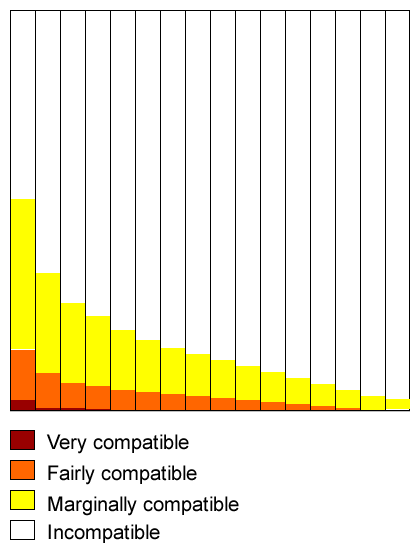
Here I present two graphs representing (approximately) romantic relationship compatibility distribution among types 1) as suggested by socionics theory, and 2) in practice (in my practice, at least). There are 16 vertical cells in each graph, representing the 16 types.

1. What socionics seems to suggest


What exactly socionics suggests is highly debatable. Some socionists introduce subtypes and use them to further model intertype compatibility. Some socionists talk of the difference between functions and the "specific content of the functions," which depends upon culture and upbringing (a copout explanation, in my view). Some introduce levels of development or intellect which may influence compatibility. Nonetheless, the above picture represents what many or most people seem to think after beginning to study socionics. It often takes many years for the understanding above to gradually morph into something more like the following:


2. What I observe in practice

The height of the colored bars may differ from person to person depending on how far they are from the mean on various physical, intellectual, emotional, and cultural traits. The graph above shows 1 in 40 duals as being "very compatible" and just over half as having some degree of compatibility. For some people even this may be optimistic.

Note that there is no "ideally compatible" category in the second graph. In my opinion ideal compatibility does not exist. It is not built into our biology. Compatibility is a kind of reasonable compromise between two individuals who agree to set aside one set of programs (mate seeking and individualistic behaviors) in favor of another set of programs (relationship building, homesteading, and child rearing behaviors). The socionics model does not reflect this in any way.

Furthermore, romantic compatibility in practice may change during a relationship. The stage of romantic love increases the appearance of compatibility greatly no matter what the intertype relation. As hormone levels gradually return to normal, compatibility may either decrease or increase depending on "underlying" compatibility. Even in a seemingly compatible relationship, there is no guarantee that for one reason or another one or both partners will opt out of the relationship.

There is substantial evidence that humans have a mixture of monogamous and polygamous tendencies and that as a species we are designed with the potential for both life-long monogamous relationships and multiple relationships, whether simultaneous or sequential. The mechanisms whereby people are motivated to switch relationships throw a wrench in the neat system of compatibility suggested by socionics. Again, socionics has nothing to say about these vital biological factors and suggests a simplistic view of compatibility that requires numerous qualifications and provisions.

Next, homo sapiens did not evolve in a nuclear society where people separated into pairs and isolated themselves socially and economically from others. For the most part, homo sapiens lived communally, and intimate romantic relationships were complemented by a complex network of other supporting relationships. In this kind of setting individual compatibility may be less important than in a distinctly nuclear society.

Finally, adult mortality was quite a bit higher than today, and it was quite common for women to die in childbirth. Health, fitness, and ability to provide were probably just as important provisions for choosing a mate as psychological compatibility. After all, what our genes are after is maximum replication. How much this goal favors the evolution of a rigid system of psychological compatibility is an interesting question (I believe I have an article about that at Socionics.us).

It seems to me that the larger and more complex the society, the lower the percentage of romantically compatible mates. As specialization and the web of interpersonal communication increase, people settle into ever more specialized cultural niches. As the complexity of society increases, people with extreme traits have more chances to find each other and produce offspring with even more extreme traits who, in turn, have a harder time finding compatible partners. In a society where one must find a mate within a community of 1000 or so people, out-of-the-norm traits may tend to be quickly brought closer to the mean because of the low probability that you will ever meet someone else with the trait.

If one can realistically choose from only 100 potential mates and knows of no others, one will find a relatively compatible mate among the 100. If there are only 10 mates, one will find the most compatible one of the 10. The smaller the number of people in a certain mileau, the less cultural and psychological diversity there will be.

Sep 21, 2011

Socionics Antidotes or Transcendence

What are the things that can allow one to overcome supposed limitations imposed by socionics theory on self-expression, self-development and interpersonal interactions?

Given that socionics is an intellectual framework, it may not be surprising that its "antidotes" are emotional and experiential in nature and involve relying on other parts of the brain in situations where one might have previously engaged in analytical thought or normal mental activity.

Put simply, the antidotes to socionics are things like compassion and instinctive, "because it feels good" behavior.

The practice of compassion is perhaps best developed in Buddhism. A quick search led me to this introductory article. The Dalai Lama also has some good writings on the subject. While experiencing compassion, you may find yourself doing and experiencing things that are hard to explain or describe socionically, like connecting deeply and meaningfully with people of every possible type. If you're honest with yourself about the experience, you may come to realize that type and quadra-based chauvinism and exclusivity are delusions and that the thinking behind them is simply erronious, despite being superficially logical.

Doing things that feel good in a holistic way is another antitode to construct-laden thought. Have you ever rejoiced in the process of physical movement, just because your whole body was working together in an efficient and pleasuresome way? Have you ever taken a dip in an ice-cold stream or lake and emerged from the water euphoric? How about building something with your own hands? Providing the body with positive holistic experiences and giving it a more significant role in your life allows you to continually take part in things that have no socionic explanation and engage universal biological mechanisms.

Postscript
I have experience leaving a semi-authoritarian religious community that fostered a variety of feelings-based delusions. The antidote to that was science and rational thought.

Sep 19, 2011

Reflections on the Value of Socionics

A Ukrainian friend mentioned today that he had discovered my socionics website on the web when trying to find my contact information online.

- "Oh God," I answered, rolling my eyes with a laugh. "I swear that's not me!"
- "So you've recovered now?"
- "Oh, for sure. 100%. Getting over socionics is a greater achievement than learning it in the first place."
- "Yeah, socionics is quite a potent Trojan."*

* My friend is a software engineer and obviously chose his metaphor carefully. "A Trojan horse, or Trojan, is software that appears to perform a desirable function for the user prior to run or install, but (perhaps in addition to the expected function) steals information or harms the system... A destructive program that masquerades as a benign application. Unlike viruses, Trojan horses do not replicate themselves, but they can be just as destructive. One of the most insidious types of Trojan horse is a program that claims to rid a computer of viruses but instead introduces viruses onto the computer" (from Wikipedia).

Some more excerpts from our conversation:

- "Socionists spend so much time talking about how to develop socionics and overcome stagnation, but the problem is not in the people or their resources, but in the fact that socionics originated and developed as a philosophical school."
- "It lacks experimental repeatability. You can spend years studying socionic phenomena and report your conclusions to other socionists, but there is no way they will be able to build upon your results."
- (Him) "Did you know there's a socionics club that meets here every Friday? I attended for a while some years ago. It was always either dismal, very dismal, or hopelessly dismal."
- "People learn a new language to be able to think about and discuss socionics, but soon they find that they can't talk to other people anymore because they don't know socionics speak."
- (Him) "I learned about socionics in 2005 and for the next year and a half basically disappeared from society. I finally realized I was free when a girl asked me what type I was and I said, 'I don't know!' At that moment I realized I didn't care anymore."
- (Me) "At this point I have no internal need to discuss socionics with anyone. Now I can easily go for a year or more without mentioning types or the 'S' word."
- "Socionics frees a person from one set of delusions, only to replace them with new ones."
- "It gives people a way to justify their own shortcomings and failings. And it leads to new types of chauvinism."

Note that at this point in the conversation we risk falling into "delusions of disgruntled ex-socionists." Sometimes negative experiences can cause people to lose all objectivity in their criticism of whatever they have left behind. In socionics, this negative experience is usually acquired at online socionics forums or at socionics clubs, schools, or conferences when a) fruitful discussion or consensus fails to materialize (due, of course, to "stupid" or "dogmatic" people) or b) there are serious disagreements about people's types, particularly that of the disgruntled person (due to "incorrect typing paradigms"). It can be hard to get over the bad experiences and gain a more objective and moderate perspective, because it means rising to a higher level of understanding than the level one was at when the bad experiences occured. That may take years and multiple major life changes.

Our conversation continued:

- "At the same time, socionics has an unmistakable kernel of truth in it — the observation that interactions with different people tend to be quite different."
- (Him) "For me, the notion of complementarity was the most important thing I got out of it."
- (Me) "And I became very attentive to people's personalities. I don't just mean their types, because once you know 20 people of the same type you start paying attention to all the things that make them different."

So it's obviously not all bad after all! In my case, I would say socionics has been more positive than negative. It was like serving in the army. You go through some hard training and earn some battle scars, but come out (hopefully) wiser for it and perhaps more of a "real man." But many people's experience of socionics is more like joining a cult; instead of performing your service and returning to the real world, the socionics community becomes your primary social outlet, socionics lingo becomes an involuntary part of your thought and speech, and you lose your desire to connect deeply with people outside of the socionics community (or try to draw them into it in order to be able to connect with them).

I sometimes wonder if the universally applicable "kernel of truth" within socionics can be separated from the parts that seem to engender negative experiences, or if the two are inextricably connected.

Now that I am "beyond socionics," I could easily imagine training another person to observe other people's expressions of personality and individuality, as well as their own responses to these expressions, without resorting to a single socionics term — even hidden terms (i.e. by replacing a "foreign" socionics term with a more familiar word). I think a person could learn to recognize and develop potentially fruitful relationships and gain more social confidence through this type of training. I can't imagine that it could have any negative effects at all. But would something important be lost with all the categories removed?

Jan 25, 2011

Products of Our Time

(reposted from my personal site because I think this is somewhat relevant to this blog)

We are products of our time — unwitting manifestations of processes that are difficult to recognize due to the small timescale of a human life.

We grow up in cultures that form our basic attitudes, which some people begin to question in early adulthood. But where does culture come from? Many elements of culture "just evolve," much like languages, in a kind of self-reinforcing way.

Ultimately, no all-encompassing answer can be given to questions such as, "why do men wear ties to work?" A satisfactory answer would have to include the history of labor and clothing, the economic factors affecting this history, and a scientific discussion of the psychological and biological basis of conformism. Even then, there's no guarantee that we've actually found an answer. There's no guarantee that if we rewound history and started the game over, by the year 2000 men would be wearing ties to work. In the rerun, some "butterfly in Texas" could flap its wings a little differently, and in the end men would be wearing turtlenecks with stripes down the front instead of collared shirts and ties. If a whole flock of butterflies flapped their wings, maybe today men would all paint their fingernails, grow pointy moustaches, and wear kilts.

But there are other, more significant, elements of culture that are much less arbitrary and have traceable material causes. I would like to discuss a few of these causes in this essay: urbanization (overpopulation), information technologies, and fossil fuels.

1. Urbanization/overpopulation

We are products of overpopulation. Most of us spend our lives surrounded by strangers and packed into urban centers — conditions very different from those in which our species evolved. Higher population density translates into more complex social structures and societal institutions, as well as more information in general. This greater complexity takes more time to understand, and more information must be assimilated before one can become a "productive member of society," so we study longer and delay creating families later. Equipped with a strong exploratory instinct, in urban conditions people can't help investigating all the options, finding out what there is in society, what goods are available, getting to know more people, and trying out more things. All these actions "distract" us from reproduction. We extend our education, pass more time investigating options before settling down with a career, and spend years picking and choosing among potential mates before finally creating a family.

Overpopulation also causes an underlying stress related to continual interaction with complete strangers. We develop conventions for formalizing superficial interactions with strangers in order to reduce stress. These include handshakes and other forms of greetings, etiquette, and conversation patterns. Once surrounded almost exclusively by close community, Homo Sapiens now spends a great share of his time among strangers. This leads to conventionalized interaction, ignoring, and avoidance. People whose natural shyness would be easy to overcome in a communal environment find themselves easily isolated in an urban setting. Even naturally gregarious people find themselves susceptible to feelings of isolation as nobody has time to spend with them.

Reproduction begins to lose its value and allure in an overpopulated society. The economics gradually change to favor small families and even bachelorhood. Land, infrastructure, and education costs rise, requiring people to spend more time working to pay their own way and, consequently, less time working to feed dependents. Children become progressively more expensive and less useful to their parents.

Despite the rising costs and risks of reproduction, the reproductive instinct remains as strong or nearly as strong as ever (due to mild chemical suppression). Furthermore, continual contact with attractive strangers provides constant low-level sexual stimulation. In addition to developing anti-contraceptives, society channels this energy into increasing autoeroticism and voyeurism (viewing sexual behavior but not engaging directly in it yourself). Nonreproductive sexual behavior is increasingly accepted and encouraged, with a plethora of goods and services available to make it easier. This ultimately serves to lower reproductive pressure and hence population. So-called moral decay, then, actually serves the noble purpose of reducing population pressure.

Population pressure is also reduced through increasing acceptance (prevalence?) of homosexuality and by the rising prevalence of psychological problems inhibiting the formation of stable relationships. The causes of relationship problems at first glance appear unrelated to population density, but I would argue that they are by-products of urbanization. Commitment avoidance, for instance, traces to societal complexity and an overwhelming amount of information and opportunities. Emotional intimacy problems probably trace to excessive contact with strangers and insufficient contact with family. In addition, modern urban life presents difficult financial and career decisions almost unknown to previous generations.

2. Information technologies

We are products of the telephone, TV, and Internet. Increasingly effective communication technologies have allowed us to maintain increasing interconnectedness despite increasing isolation. Thanks entirely to telephones and, later, the Internet, each individual now maintains a staggering network of instantly available contacts, many of whom he will never see again in his life due to the vastly increased mobility of individuals (thanks to fossil fuels — see below).

As a result of increasing access to information, modern urbanites are now incredibly knowledgeable about things that have little to do with their personal circumstances. Our innate curiosity receives outlets that previous generations couldn't have dreamed of. Any question can be answered, any fact discovered, with just a few mouse clicks. A side effect is impatience with lack of knowledge — our own or others'.

Quick and easy means of communication favor short, spontaneous interactions. Messages become shorter and generally more mundane. Gone is the art and practice of letter writing. We lose our sense of distance; each friend or contact with Internet access becomes equidistant. Eventually all our friends are "contacts," and all our contacts are "friends."

A result of the growth of information technologies is information overload. The TV has more channels than you can watch simultaneously, and TV programs run round the clock. Everyone is available at the same time via phone or Internet. The Web never sleeps, and its content never stops growing and changing. Our biology predisposes us to become "information exchange junkies," and it's easy to become a genuine addict with information "fixes" so easy to obtain.

As a result of all this information, we're spending less time than ever on physical pursuits, and our minds are often overstimulated while losing some ability to focus. The more information there is, the less time we spend digesting each portion of it. A bit of depth is sacrificed to breadth. But the new breadth is incomparably vaster than the old.

Information technologies also feed our increasing autoeroticism and voyeurism by offering personal sexual and emotional adventures whenever we want through online pornography, chat rooms, and socializing. This can translate into decreased motivation to pursue person-to-person sexual and emotional contact, which contributes to the depopulation trend described above.

3. Fossil fuels

Fossil fuels are the reason why widespread urbanization (overpopulation) and the development of information technologies were possible in the first place. Fossil fuels have also produced their own unique set of unique culture-forming circumstances, described in my article on fossil fuels and their influence on communities and health. The main derivatives of industrialization are sedentarism, individual mobility, and rootlessness.

It's hard to fathom how much our attitude towards our bodies has changed as a result of industrialization. Our bodies have become basically irrelevant to our professional success. Healthcare has become institutionalized as a result of industrialization, urbanization, and advances in medicine and is no longer the full responsibility of the individual. At the same time, our outward appearance is still important for developing relationships, perhaps more so than ever now that we spend so much time among strangers.

The functionality of the body — that is, its ability to perform various tasks — is no longer of much economic significance. Those who continue to develop their bodies do so more for aesthetic than for practical reasons. Freed from the constraints of daily physical labor, the body has become a kind of art form to be honed and looked at by others, or simply be kept hidden under a layer of clothing. At the same time, industrial society presents formidable obstacles to maintaining a physically healthy lifestyle, and many people are unable to keep their bodies in good aesthetic shape. Orthodontics, cosmetics, and clothing today allow one to make a good impression despite an undeveloped physique.

Mobility — made possible by liberal capitalism and modern transportation infrastructure — allows us to choose from a greater number of life options than ever before. Not only can one choose from a plethora of professions, but one can also live almost anywhere one wants. More options means more time needed to make choices. Mobility contributes to delays in reproduction and increased social isolation mentioned above. Society-wide effects of mobility are discussed in the article linked to above.

One of those effects is widespread rootlessness. People who can go anywhere they want tend to have weaker ties to place. Furthermore, national culture becomes more uniform through deep-level cultural interchange facilitated by large-scale movements of people. A rootless person becomes, statistically speaking, more cosmopolitan, less devout, and less patriotic with regard to his land of birth. On the other hand, the personal benefits to be gained are often irresistible: professional opportunities, economic gain, and adventure.

Conclusion

Urbanization, overpopulation, information technologies, industrialization, and fossil fuel-derived mobility have formed a new kind of person — the individualistic, independent yet financially indebted, information-consuming, erudite, autoerotic, voyeuristic, morally decadent, rootless, highly mobile yet sedentary, aesthetically physical, emotionally isolated but socially connected Modern Urbanite.

This process is taking place across the entire globe and has reached an advanced stage in places as diverse as New York, Tokyo, Frankfurt, Shanghai, Moscow, and Sydney. Chances are, if you're reading this, a good two-thirds or more of what I've written applies to you.

Jan 20, 2011

Introverted Intuition and Mystical Experience

Here is my response to a reader's letter, which is posted at bottom:


Your first question — "what exactly is Intuition of time" — is hardest to answer. The simple answer is that it is the internal experience of physically intangible phenomena. Ask 10 different socionists, and you'll get 10 different answers. But there is nothing inherently "mystical" about introverted intuition.

According to socionics, every function is responsible for both input and output — perception and behavior (passive and active "uses" of the function). Every type has all the functions and thus, at least to some degree, all the perceptive and behavioral potentialities of all the other types, however, the functions have different roles and importance for different types.

Next, what exactly is a mystical experience? Once you have defined it, can you assign that type of perception/behavior to a specific function? I suspect you cannot. Most people occasionally experience unusual states where their consciousness expands into unusual territory. This ability seems to me to be mostly unrelated to type. But is this what you mean by mystical experience? If you mean some type of totally otherworldly experience, then that is something that is indeed rare. I certainly don't have it, and most other people don't, either. This also suggests it's unrelated to socionics, because something socionically related should be more or less universal, while having different importance for different people.

If by mystical experiences you mean your own "beautiful impressions and poetical dreams," these are probably more or less universal. Almost everyone has these. Not the fact itself that you have impressions and dreams, but perhaps some of the content of your dreams and impressions is related to your specific socionic type, just as it is related to your basic personality and temperament.

I'm interested in transpersonal psychology. So I wanted to know, what exactly is Intuition of Time? Socionists believe, that this function is responsible for mystical experiences. So, can I ask an answer in simple English, why there is that function? How it makes mystical expreiences real. Why do socionists believe that it comes from this world and how sure we can be in that? Is this understanding final? Or is there place for other worlds?
I have a weak intuition, but I'm thinking that weak intuition too can have such experiences. I have had beautiful impressions and poetical dreams. But, are, in orthodox socionists understandings, the mysticism available only to strong intuiters?

Another Book on Socionics in English!

Soon I'll have to start running a list of books on socionics in English. We are at what, 4 already? I sense exponential growth... Let us hope that quality is improving along with quantity.

MBTI and Socionics: Legacy of Dr. Carl Jung


The authors are no-names in the socionics community and have no online presence (I tried googling them in Russian and English), but that is not necessarily a damning flaw, though it is cause for suspicion.

A cursory reading of what contents of the book are available on Amazon confirmed those suspicions:

  • "Introverts have pale faces, often with naturally dark hair."
  • "Extraverts... have a lighter hair color than introverts, and almost everyone I met with reddish hair is an E**J type."
  • some typos and awkward phrases
Obviously (I hope — to readers of this and other socionics sites), these generalizations are false. There is no correlation between the degree of contrast between facial tone and hair color and the introversion/extraversion dichotomy. I don't know where these people get such ideas. Apparently, there's something about the way socionics was originally presented by Augusta and others that has encouraged people to look for magic physiological identifiers where none exist. This is how horoscopes and superstitions maintain their popularity despite all rational argumentation against them.

It is unfortunate that the author includes happenstance physical observations in dichotomy definitions. Also, the definitions are full of phrases along the lines of "some people say," "some introverts," "I think that." Definitions should be as absolute as possible and should focus on the key qualities rather than being collections of anecdotal observations and extraneous information.

More issues:

  • "The carriers (of introverted logic) are good at mathematics"
  • and similar statements
When dealing with exceptional individuals (smart, well-coordinated, or gifted in one or more ways, etc.), all bets are off on the correlation of functional preferences to actual professional skills. Why create definitions that rule out exceptionality from the outset? If you take this route very far, it leads to pigeonholing all smart people into 2 or 3 types. As a result, intertype relations get all messed up.

So far, I am not impressed with the style and content of the book and did not get the impression that the author is a socionics expert with a socionics awareness much higher than the average online aficionado.

Some readers may think I'm being too hard on the book (which is typical of experts on a field commenting on others' writings), but this book really does appear to be amateurish and misleading.

Jan 18, 2011

List of Books about Socionics in Russian

This is in response to an e-mail I received. I thought the information might be useful for other readers:


As you can see, electronic versions of some of the books are available online, albeit illegally.

Nov 1, 2010

Individual Differences in Focus and Attention Span

I have observed considerable differences in people's ability or desire to focus and the frequency with which they tend to move from one object of focus to another. The chart below sums up my observations in a sort of typology. In reality, both dimensions form a continuum, and each person is capable -- to some degree -- of operating in each state. But many or most people will be able to identify a primary state or two that they tend to spend most of their time in. I presume one's childhood personality can provide clues to help identify one's main operating quadrant or at least one's location along the continuum.

The chart below lists types of activities that correspond to different states of mind as well as broad personality traits. I think these traits are inborn, but it might be that childhood mental stimulation patterns (e.g. TV viewing, computer and video games, etc.) can permanently alter (shorten) one's attention span. Furthermore, people may go through periods (particularly their high school and college years) where they are more mentally focused, but then leave this state behind them after graduation.


The chart might also help identify the necessary state of mind to develop for a particular type of activity that one wants or needs to do. For instance, effective book study requires a highly focuses, undistracted state of mind (quadrant II). Achieving this will be easier for someone of this type and harder for people of other types. One can improve one's chances of success by choosing a time of day and environment when one's mind tends to be sufficiently calm and distractions are minimal. Also, there are useful tricks such as underlining, highlighting, and outlining that can improve one's ability to absorb complex information.

People who are typically calm and nonverbal may have problems getting to state I, which requires an active mind and mouth and quick reactions. Likewise people from quadrant I may find the idea of slow, repetitious activities almost unbearable, while people of type II may find them enjoyable and relaxing as compensatory activities. People in quadrant III may have a hard time building up the energy and concentration to engage in the solitary, focused activities of quadrant II, and people of type II often feel lost when in a type III environment.

In general, it seems that people move fairly easily between adjacent quadrants (i.e. from I to II or from I to III) but have difficulty engaging in activities from diagonal quadrants (i.e. IV from I). Again, both dimensions are continuous, so this pattern is most obvious for people at the extremes.

My next observation is that this typology is only loosely related to socionic types. For instance, among ILEs and IEEs types I and II are both common. Differences in attention span between people of the same socionic type can be especially drastic. One ILE manager and entrepreneur confesses to "never reading any books" while another spends many hours a week engrossed in personal study. The first speaks rapidly, is constantly communicating with other people formally and informally, answers dozens of e-mails a day (sending short, carelessly formulated replies), browses the Internet several hours a day, and spends little time alone. The second speaks more slowly and deliberately, spends many hours a day alone studying and writing, is meticulous and analytical, and spends only a few hours a day with other people, mostly choosing companions who share one or more of his interests.

I think what I am calling "short and long attention span" basically corresponds to what modern psychology terms "extroversion and introversion."

As a type II person, I enjoy my type IV compensatory activities and my occasional forays into type I, but type III people are as if from another planet. When I find myself "wasting time" on casual unfocused activities that are the norm for many other people, I feel disoriented, often disheartened, and need time to recover and get back into my usual groove. I imagine the same would be true for them in a type II environment. One way I have created a better environment for my mostly type II life is by eliminating TV and Internet at home -- two instruments that break down one's attention span and ability to engage in productive activities for extended periods of time. My type I acquaintances don't understand my decision because they aren't so easily disoriented by high levels of stimulation.

An interesting consequence of this typology is that people of relatively incompatible types can end up in the same quadrant. Quadrant II, for instance, can include both IEEs and LSIs, IEIs and LSEs. Quadrant I often has SEEs along with ILEs and ESEs along with LIEs. The solitary, meticulous work of accountants requires focus and attention just like the solitary research of an academic, even though the two activities are very different and two people of these professions might not get along. Type II can include both rigid and liberal individuals.

There is probably a tendency for more women to be in quadrants III and IV and more men to be in I and II. Author John Gray has written extensively about women's more open and receptive consciousness and men's greater focus, while recognizing that some women possess more "masculine" qualities and vice versa. In traditional cultures it is commen for women to get together to engage in light repetitive handwork (weaving, knitting, etc.) while engaging in conversation and social bonding. This would correspond to quadrant IV or III depending on whether more emphasis is on the physical activity or on socializing. Of course, if some guys get together for jogs through the park, that is also quadrant IV. Among the specialists of quadrant II males clearly predominate. Here you find people whose main purpose in life appears to be skill acquisition or knowledge production. Women can also be found in quadrant II, but their biological program requires them to be capable of letting go of personal pursuits for a while and be receptive to the needs of their dependent offspring. It should be noted, however, that the degree of gender differences varies from culture to culture, with masculine cultures (Japan, Austria, Italy, Switzerland, Mexico, U.K., USA) exhibiting greater gender differences than feminine ones (Scandinavia, Chile, Portugal, Thailand, Guatemala, etc.), according to researcher Geert Hofstede (who unfortunately left many countries out of his analysis, particularly the Soviet bloc and the Arab world).

Some readers may note similarities between my quadrants and the time management matrix of Stephen Covey (i.e. urgent vs. non-urgent and important vs. unimportant activities). I also noticed this, but I don't think the two systems have that much in common.

Sep 11, 2010

Socionics and Friendships Between Couples

If finding friendship with one other person is hard, try finding friendship between two couples. What does is take? Each member of both couples must find at least one friend among the other couple in such a way that all members are included. If any one person is left out of friendship, the couples are not entirely friends.

In the best case scenario, all four people are friends with all other three. This is rare, but happens. However, even this arrangement is fragile. A shift in the life circumstances of any of the four people can upset the balance and change the character of the friendship. The probability of such a shift happening in any given year is substantially higher than that of a shift happening among a single couple (a relatively high probability to begin with.

For instance, if a single individual has a 20% chance of a major shift in circumstances in a given year, then a couple has a 36% chance that one or more will experience a shift, and a set of two couples -- 59%. This is just to illustrate why close friendships between two couples are less stable than between two people.

What intertype relations might be more favorable for such a friendship? Among any four people, there is a dizzying variety of possible combinations of intertype relations. And yet, some tend to be more common than others.

It's easiest to recognize friendships between two dual couples. In my experience, it seems relatively common to have:

  • dual couples
  • activator couples
  • semi-duality couples
  • extinguishment couples

(where the relationship is defined by the intertype relation between any two individuals of the same sex)

A relationship between two couples may become unstable if there is cause for attraction between any two members of the opposite sex. Therefore, identity relations between couples are rarer than duality, and mirror rarer than activator. Identity friends typically have to keep their spouses out of the friendship to avoid sparking jealousy and concealed sexual competition between the two males or two females.

Since I have a lot of activator friends, I frequently encounter the "activator couple" scenario. Do couple friendships form in all cases? Only in about a third at most. It seems that most such friendships are saboteuged by rejection between "mirrors." In other words, an IEE and LSE may be close friends and may want to include the spouses in the friendship, but either the SLI spouse rejects the LSE or the EII spouse rejects the IEE.

There seems to be no surefire way of predicting rejection. It seems particularly common for the dual spouse to perceive the activator friend as a competitor for influence on the spouse. The more time the two spend together, the less time the dual gets with his or her spouse.

So, you can see how difficult it is for even an activator couple friendship to materialize. The likelihood of rejection between two opposite sex "mirrors" is quite high.

Paradoxically, more socionically distant relations between couples may be "safer" in the sense that the same sex friend of your spouse is less likely to be perceived as a direct competitor to you. However, such relationships will also likely not develop the same degree of closeness and trust.

Non-dual couples

As soon as we introduce non-dual couples, things get more complex since the likelihood of imbalance between the intertype relations of one member of a couple and the other member rises.

For instance, a LIE-ILI (mirror) couple (male member listed first for consistency) may become friends with a ESI-LIE couple (dual). In this scenario, two people get a dual relation out of the friendship, one gets an activation relation, and one gets "just" a mirror relation. It's easy to see that here the relationship will hinge mostly upon the ESI, who is "needed" by everyone else. Probably, the other three will only be able to talk amongst themselves, but when the ESI comes around, varied activities will become both possible and fun. It's typically hard to have extended fun with identity partners, mirror partners, kindred partners, etc.

The ideal friends for a LIE-ILI couple might be a ESI-SEE couple, but what are the odds of finding one? Likewise, the ideal friends for a LSI-SEE couple might be an EIE-ILI couple, but I would the odds of two such couples finding each other would be very low indeed.

Generally, it seems that the less socionically favorable the intertype relation between a couple, the more difficult it is to maintain friendships with other couples.

Other factors

To avoid sociono-centricism, it should be noted that the less favorable AND stable a couple's relationship is in general (not just in socionic terms), the greater difficulty they will have maintaining friendships with other couples. This applies to duals with an instable relationship just as much as to non-duals with a stable relationship. Can duals have an instable relationship? Of course. (Nonetheless, dual relations appear to be more common than others.)

Furthermore, in practice friendship is based not so much on socionics ("we just feel good around each other -- that's why we're friends") as upon shared interests and history ("we enjoy doing X together, we've been through a lot together, we have a lot to talk about"). Socionic factors certainly influence the likelihood that two people will become and remain friends, but it is far from a 100% determiner.

Looking at interests may help to explain the frequent "mirror rejection" pattern mentioned above. When two activators become friends, they most certainly share some interests and commonalities in values. These shared interests and values won't extend to all areas of life, but they're definitely enough to justify spending time together doing something of mutual interest and talking about life. However, what you share in common with an activator may not be what they share in common with their dual.

For instance, I am passionate about backpacking and the outdoors. A lot of my activator LSE friends have also somewhat enjoyed backpacking -- enough to make trips together generally worthwhile and fun. But what is the probability that someone who enjoys backpacking somewhat, but not passionately like I do, will choose a spouse that also enjoys it? Probably under 50% (the more passionate one is about something, the higher the likelihood they will choose a spouse that shares or sympathizes with the interest). And there you have one possible reason for rejection. The friend's spouse doesn't enjoy or understand backpacking, and is mistrustful of people who make it a central part of their life. Probably, if we were to dig deeper, we would find some other fundamental value differences underlying an interest or disinterest in backpacking that would make itself felt in other ways.

Each thing that just one of the friends is particularly passionate about is similarly prone to cause rejection or mistrust on the part of the other friend's spouse, who, more likely than not, does not sympathize much with the passion.

What seems to increase the likelihood of a compatible intercouple relationship is when both activation partners are equally passionate about their key shared interest/s. This means that it is likely that both have chosen spouses who are at least accepting of and somewhat interested in the area of passion. In this case, everyone can participate and experience enjoyment both from the activity and from the conversations that inevitably result.

But "equally passionate" is just another way of saying that the activator friends are more compatible than two friends who are unequally passionate about their shared interests. Many parameters of compatibility are not encompassed by socionics. Higher compatibility between friends increases the likelihood of compatibility between their spouses and between both couples. If you and your friend have built a friendship upon mediocre compatibility, it is less likely that your spouses can be included successfully in the relationship.

Leaving socionics behind for a moment, friendships between couples are more likely to form on the basis of a common interest or interests among all four members. Socionics becomes one of the limiting factors to the relationship and will tend to make itself felt during longer interaction sessions involving a greater variety of activities (for instance, not just talking about or doing the common interest/hobby, but also eating together, planning logistics, relaxing afterwards, etc.).

Even among two highly compatible couples (say, a complete quadra) differences will arise where one or two people dissent from the majority approach. Dissention can occur on the basis of irrationality-rationality ("I don't like how they don't warn us about what they're going to do"), on the basis of gender ("I'm tired of everything having to be so goal-oriented; why don't you and I take a walk around town together while the men do their thing?"), on the basis of sensitivity ("I just want to be alone for a while"), or any number of other things.

To sum things up, friendship between couples is more difficult and complex than dynamics between two people. Intertype relations between the two couples play a significant role in choice of intercouple friends, but there are a number of other important factors determining the possibility of friendship.

Socionics and Homosexuality

Recently I have had more contact with homosexuals than before and have thought a lot about homosexuals I have known and about past acquaintances I now suspect are gay. I've tried to pinpoint their commonalities and psychological peculiarities compared to heterosexual men or women, particularly those of the same socionic type.

My first observation is that in every case I find it difficult to type these people. In addition to their socionic type there is something else that appears to "cloud" the type (actually, my idea of the type). For instance, a gay LSE might talk about and express his feelings in a way that makes me suspect he's actually an ethical type. Or a gay SLE might lack the male dominance and seem more passive or even insecure than is generally typical of the type. These are just some possibilities. In most cases I still can't identify the types for sure.

I've found that in some cases it helps to think of the gay man as a woman, and then understanding his personality becomes easier. Likewise for lesbians.

Another thing I don't understand is how intertype compatibility plays out between homosexuals. I'm used to seeing heterosexual couples where masculine men choose feminine women or somewhat effeminate men are with somewhat tomboyish or "manly" women. I don't understand the attraction between two men who both appear effeminate. Perhaps it is more common for one partner to be more masculine and the other more feminine.

I also don't know if there is a correlation between socionic type and the tendency to take a masculine or feminine role in homosexual relationships. It is slightly tempting to hypothesize that logical types gravitate towards a masculine role and ethical types towards a feminine role, but I suspect the correlation, like always, is not neat.

Among people of a single gender and type I find a fairly wide range of masculinity, femininity and other characteristics. It's not impossible to imagine, for instance, an effeminate ILE with a gay partner who is a masculine SEI. Presumably effemininity among males has only a partial, very far from absolute correlation with homosexuality, and sexual preference is determined by something other than dosages of testosterone and estrogen during prenatal development.

I invite people with more experience and knowledge to share their observations and ideas.

Sep 10, 2010

"Personality and Individual Differences" Journal

As I've stated before, I'm interested in finding physiological mechanisms behind personality differences and relationship choices.

Here's the link to abstracts of the journal Personality and Individual Differences since it first came out in 1980: http://www.sciencedirect.com/science/journal/01918869

Readers may find it interesting to browse through the abstracts and take in the refreshingly empirical approach, though it usually produces mundane results.

If anyone knows of better sources in this field -- perhaps something that separates the wheat from the chaff -- please post a link.

Perhaps somewhere between the plodding, generally unenlightening empirical research machine that is modern academic science and the intuitive, oversimplified, and semantics dependent philosophizing of socionics and other typologies a connection can be made that spawns a new and better theory of personality and relationships.