Showing posts with label anthropology. Show all posts

Feb 27, 2019

Non-duality as an Adaptation to Separation

Human psychology evolved for the hunter-gatherer lifestyle, but for many thousands of years most of us have not been living that life.

If you've ever been on an expedition or part of some intense team experience that lasted three days or more, you will probably have experienced a significant loss of "ego": far fewer thoughts about your "self" and your personal story and far more spontaneous responding in the here and now. Maybe you felt it at Burning Man, on tour, or during that week when your whole team was holed up in the office finishing off (or starting) a project.

Over recent millennia life has become more and more separate for most of us: the teams have become progressively smaller, the strangers more numerous, the cooperation less intense.

Chances are, if you're reading this, you are alone right now. The way you are living would cause profound anxiety to a hunter-gatherer, who would interpret the situation as fraught with danger.

You may even be living alone. That means cooking alone, washing alone, and cleaning alone. You've got a complete set of home conveniences which previously would have serviced a multi-generation household. And several generations before that there would haven't been any of those conveniences.

Things have gotten particularly "bad" in the past 70 years. Average household size in most countries is plummeting and will soon be below 2. In fact, household size is as good a proxy as it gets for how "modern" or "progressive" a country is. The larger the households, the more "backwards" or "traditional" the society.

In their unadjusted state, humans are bound to suffer in this unnatural lifestyle, like a polar bear at the zoo who endlessly paces back and forth in its cage.

But there is an upgrade, a "tweak," and it's been around for thousands of years — presumably as long as cities have been around: the experience of non-dual oneness.

Non-dual oneness is a shift in the experience of the self from a separate, localized self to a self which is impersonal and universal. It is the mental hack that frees you from the anxiety of living separately while being surrounded by throngs of strangers.

Without the mental upgrade, modern living is bound to leave you low in oxytocin, serotonin, and other neurochemicals, and high in anxiety. From a hunter-gatherer perspective, you are trying to get by on your own in a hostile universe. You're basically ostracized from your tribe.

But these feelings aren't based in reality. There is no one out to kill and eat you. All your needs are met. And nobody has ostracized you. But without the non-dual "hack" you cannot fully assimilate this truth. You may understand intellectually that there is nothing to worry about, but your subconscious doesn't believe it.

With the hack, you can continue your apparently "separate" lifestyle with no loss of neurochemicals and no persistent anxiety or stress.

Some of the first to systematically figure this out were hermit monks who would spend months living in inhuman conditions in caves to train themselves to produce oxytocin without human contact, serotonin in the absence of social support, and all the other neurochemicals they needed to feel good. Of course, to reach this level they had to first undergo extensive training — typically years of special mental exercises. An untrained person would wither and die from the experience.

Today interest in the "hack" is growing proportionally to the apparent dysfunctionality of modern life.

Could there come a time in the not-so-distant future when the non-duality patch comes installed by default?

p.s. There is at least one other "hack:" pets! :-) But it's not as complete a hack as non-dual oneness.

Apr 6, 2014

Some Thoughts on Relationships and Socionics

The last 9 months have been very good for me. My life has been steadily getting better and better, and I think I understand enough about why the changes have been taking place to maintain them indefinitely. I'm referring to all sorts of changes relating to nutrition, exercise, sleep, hormones, and neurotransmitters, and also to relationships, social life, work, life strategy, and inner development.

Along the way, I have begun to think about socionics again at times. The first time was when I was pursuing a girl who seemed responsive and interested, but the interaction seemed chronically unstable and off-kilter. After a few frustrating weeks of this, I had the thought, "I wonder what socionics could say about this?" I'll admit that making a good guess at identifying her type (a LIE with a high degree of interpersonal sensitivity) brought some clarity and helped explain the imbalances in the interaction.

Since then I've occasionally (but not automatically) referred to socionics when thinking about other relationships. Experiences with other girls, however, have not exactly fit the socionics model. For instance, I had a fulfilling short-term relationship with an EIE ("quasi-identity"). Luckily, I no longer take socionics very seriously and do not let it influence my romantic choices before the fact. If I did, I might limit myself and fail to obtain experience that conflicts with the socionics model. I think I did this in the past.

Interestingly — as with any idea system — the people who engage in developing socionics are precisely those who take it very seriously... This introduces biases and ideological "overshoot" that the less interested may notice, but rarely take seriously enough to do anything about. Within socionics, as soon as people start to strongly doubt the model, they usually leave the community or become less active and just complain about the discrepancies in the background. Naturally, this is a more or less universal characteristic of schools of thought.

I now believe — as a kind of personal rule — that any relationship can or should be pursued if there is passionate interest. 100% interest and sincerity seems to be a much better predicter of having a really positive experience than socionic factors. However, this assumes that you have the maturity and wisdom to not overstep the natural bounds of the relationship and to not force it to be something that it cannot.

Some people (a lot of men) experience strong romantic interest on a daily or weekly basis. They have to find different rules and formulas for deciding how to pursue relationships and may not relate well to my ideas.

Another observation I've had is that a person may go through stages where they become more or less receptive to different kinds of interaction. For instance, when I am in a "socialite" stage focused mostly on my external social life — going out, meeting people, and doing things with others — the whole type thing can be more or less irrelevant. However, if I enter a more work-focused stage with a lot of focused solitary activity, my need for closer and more "high-quality" relationships increases.

I'm suggesting that in some circumstances a person can be perfectly happy without any dual relations or even any close tet-a-tet relationships. As a person's activities become more focused and idiosyncratic, the need for focused and idiosyncratic relationships seems to rise as well.

In the hunter-gatherer societies that produced modern homo sapiens, people experienced much tighter group relationships and less individualized tet-a-tet relationships. The idea of finding "soul mates" in such circumstances becomes largely irrelevant. I believe that a failure to understand or even think about the relationship structure of primitive societies has led to many of the erroneous ideas contained in socionics. As some readers may know, Augusta Augustinavichute believed humans were a pair-forming species and examined their relationships in a modern (actually, Soviet command economy) context only.

I've had the chance to mingle in a lot of different groups of late. Certainly, different groups have their different "feel," and socionic quadras is one way to look at it. However, some of us are used to feeling like outsiders in virtually every group we find ourselves. Thus, using comfort level as a way to identify quadras may lead to never finding one's own quadra because every group is uncomfortable — just to different degrees. For such people, the idea of quadras and their defining role in establishing the culture of a group can be pretty much irrelevant.

In a "socialite" period of life, you may flit from group to group with ease, but few of the groups are particularly well-established or display any set rules and "quadra flavor." As your life becomes more work-focused, you will probably find yourself spending time in more well-established groups. Obviously, the longer a group has existed and the more fixed its membership, the more rigid the culture of the group will be. I think there's much value in belonging to such a group(s) at some point in life.

I often return to the concept of "highly sensitive people" and observe how these people systematically do not fit into socionic type and relation models. They might as well be a different ype, and can be divided into extraverts (roughly 1/4 of HSPs) and introverts (roughly 3/4). Most are intuitive types, but there are also some introverted sensers among them.

I really strongly doubt that an HSP IEI's ideal match will be any kind of SLE, though many aspects of the relationship may be comfortable and convenient. But an HSP is subject to some kinds of feelings and experiences (states of sensitivity, solitude, loneliness, restriction of sensory stimulation, etc.) to a much greater degree than non-HSPs, and will need to find others who can relate to this "deeper" level. If an HSP lacks a deeper sensitivity-based connection with his partner, he may experience loneliness and even alienation.

I find that HSPs tend to have a mixture of intuitive and sensing qualities and often logical and ethical qualities that perhaps make it less important to have a partner who is at the opposite end of these axes (particularly intuition/sensing).

I'm not sure these axes are even a good way to think about relationship compatibility anymore. One of the reasons they enjoy popularity it because they give people them something to think about before the relationship has occurred. It can actually be akin to voyeurism. By thinking about your compatibility or incompatibility (or that of other people) with someone before a relationship has actually begun, you can 1) fantasize about a relationship that does not yet exist, 2) fantasize about other people's relationship (this is more of a female thing), and 3) justify your own inaction in pursuing someone you are attracted to.


I have a lot more to say on the subject of relationships and well-being, but it is all unrelated to socionics, so I will just abruptly end this post here.

Oct 3, 2011

Socionics Inaccuracy in Relationship Compatibility

In my opinion, socionics is inadequate as a predictor of romantic compatibility. It is quite a bit better than chance, which is remarkable in itself. However, it does not live up to the expectations many people acquire when studying the theory.


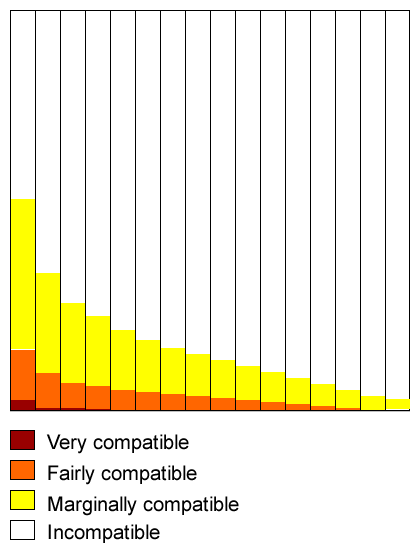
Here I present two graphs representing (approximately) romantic relationship compatibility distribution among types 1) as suggested by socionics theory, and 2) in practice (in my practice, at least). There are 16 vertical cells in each graph, representing the 16 types.

1. What socionics seems to suggest


What exactly socionics suggests is highly debatable. Some socionists introduce subtypes and use them to further model intertype compatibility. Some socionists talk of the difference between functions and the "specific content of the functions," which depends upon culture and upbringing (a copout explanation, in my view). Some introduce levels of development or intellect which may influence compatibility. Nonetheless, the above picture represents what many or most people seem to think after beginning to study socionics. It often takes many years for the understanding above to gradually morph into something more like the following:


2. What I observe in practice

The height of the colored bars may differ from person to person depending on how far they are from the mean on various physical, intellectual, emotional, and cultural traits. The graph above shows 1 in 40 duals as being "very compatible" and just over half as having some degree of compatibility. For some people even this may be optimistic.

Note that there is no "ideally compatible" category in the second graph. In my opinion ideal compatibility does not exist. It is not built into our biology. Compatibility is a kind of reasonable compromise between two individuals who agree to set aside one set of programs (mate seeking and individualistic behaviors) in favor of another set of programs (relationship building, homesteading, and child rearing behaviors). The socionics model does not reflect this in any way.

Furthermore, romantic compatibility in practice may change during a relationship. The stage of romantic love increases the appearance of compatibility greatly no matter what the intertype relation. As hormone levels gradually return to normal, compatibility may either decrease or increase depending on "underlying" compatibility. Even in a seemingly compatible relationship, there is no guarantee that for one reason or another one or both partners will opt out of the relationship.

There is substantial evidence that humans have a mixture of monogamous and polygamous tendencies and that as a species we are designed with the potential for both life-long monogamous relationships and multiple relationships, whether simultaneous or sequential. The mechanisms whereby people are motivated to switch relationships throw a wrench in the neat system of compatibility suggested by socionics. Again, socionics has nothing to say about these vital biological factors and suggests a simplistic view of compatibility that requires numerous qualifications and provisions.

Next, homo sapiens did not evolve in a nuclear society where people separated into pairs and isolated themselves socially and economically from others. For the most part, homo sapiens lived communally, and intimate romantic relationships were complemented by a complex network of other supporting relationships. In this kind of setting individual compatibility may be less important than in a distinctly nuclear society.

Finally, adult mortality was quite a bit higher than today, and it was quite common for women to die in childbirth. Health, fitness, and ability to provide were probably just as important provisions for choosing a mate as psychological compatibility. After all, what our genes are after is maximum replication. How much this goal favors the evolution of a rigid system of psychological compatibility is an interesting question (I believe I have an article about that at Socionics.us).

It seems to me that the larger and more complex the society, the lower the percentage of romantically compatible mates. As specialization and the web of interpersonal communication increase, people settle into ever more specialized cultural niches. As the complexity of society increases, people with extreme traits have more chances to find each other and produce offspring with even more extreme traits who, in turn, have a harder time finding compatible partners. In a society where one must find a mate within a community of 1000 or so people, out-of-the-norm traits may tend to be quickly brought closer to the mean because of the low probability that you will ever meet someone else with the trait.

If one can realistically choose from only 100 potential mates and knows of no others, one will find a relatively compatible mate among the 100. If there are only 10 mates, one will find the most compatible one of the 10. The smaller the number of people in a certain mileau, the less cultural and psychological diversity there will be.

Nov 10, 2008

Partner Selection in Tribal Communities

I would like to continue the theme of my previous post in a more speculative vein.

With the low probabilities of finding an ideal partner I showed in the previous post, one might wonder how people in small tribal communities of approximately 150 people* ever experienced emotional intimacy... And these are the conditions where human psychology evolved in the first place.

First of all, with a shorter life expectancy, we can suppose that not 1 in 4, but 1 in 2 people were of the right age range for an intimate relationship. But wait... due to the large number of children in tribal societies compared to our own, the proportion would actually be about the same as it is today, so we'll leave it at 1 in 4.

Next, because of the small size of communities and the inbreeding that was bound to occur, the IQ range present in any one community was almost certainly such that almost everyone was within "reach" of almost everyone else.

If we stop at this point, we have a chance of 1 in 256 for finding an ideal partner for members of tribal communities. This would mean that about every other person could find a potential ideal partner within his own community; the rest would have to settle for "next best" or look for a partner among neighboring communities. This is still assuming, of course, that every "ideal partner" is also available! We have not yet addressed the issue of eligibility ("marital status").

However, type distribution was almost certainly not uniform in tribal communities, which would have tended to develop a dominant quadra or set of types in order to remain stable. This non-uniformity would tend to be more pronounced in smaller communities. This means that for most people in the community, the chance of finding an ideal partner within the community would be higher, and for a minority the chances would be lower. Such people would be more likely to leave the community to find an ideal match or to remain single, which would perpetuate the quadra or type dominance already in place in the community.

So, what we get is a situation where a majority of people in the tribal community can find an ideal intimate partner within their community of roughly 150 people (whether or not that person is available for a relationship), whereas the rest must look outside their community for a satisfying intimate relationship.

We know that tribal communities were (are) never completely isolated, but had considerable contact with neighboring communities, just like any animal community. This increased the "dating pool," so to speak. However, it is safe to assume that most people's closest relationships were with other people in their own community; otherwise, these communities would have ceased to exist as a distinct entity. Most likely, a large portion (40-80%) of people also chose mates from among their own communities, while the rest "spread their genes."

As shown here, the search for psychological compatibility could have been one of the factors contributing to the interchange of genes between tribe, in addition to already recognized traits such as the "explorer instinct."

This may be even more speculative than the above, but it seems to me that the number of psychological types was limited by the size of human communities. If psychological compatibility is at all an important factor for survival and success, evolution could not have produced a situation where, due to the large number of psychological types (say, 256 instead of 16), only a small minority of people were able to experience it.

The size of communities was, in turn, determined by the economics of food consumption and cooperation. These "economics" determined the degree of psychological differentiation possible within human communities, as well as the minimum average number of compatible partners available to members of human communities. That average number cannot be much below 1 if compatibility matters at all to evolution.

* Note: read this article to learn where the number 150 comes from when estimating typical community size.